Quick answer
A geothermal heat pump heats and cools a home by moving heat to and from the ground, which stays at about 45–75°F year-round. ENERGY STAR models deliver a COP of at least 3.6, so they use 25–50% less electricity than air-source heat pumps (DOE). Installed systems commonly cost $15,000–$40,000 or more, mostly for the ground loop.
Key facts
- 45–75°F: typical shallow ground temperature range across the US, depending on latitude (DOE).
- COP 3.6 / EER 17.1: ENERGY STAR minimums for closed-loop water-to-air geothermal heat pumps (spec effective 2012).
- 25–50% less electricity than air-source heat pumps (DOE guide to geothermal heat pumps).
- 24 years for indoor components and 50+ years for the ground loop (DOE Energy Saver).
- Dec 31, 2025: the federal 25D credit ended for systems placed in service after this date (IRS).
On this page
- How does a geothermal heat pump work?
- What are the types of geothermal loops?
- How is a geothermal heat pump installed?
- How efficient is a geothermal heat pump?
- How much does geothermal heat pump installation cost?
- What is the payback period for a geothermal heat pump?
- Why is my electric bill so high with geothermal?
- Is there still a tax credit for geothermal heat pumps?
- Geothermal vs air-source heat pump vs furnace: which is best?
- What are the pros and cons of geothermal heating and cooling?
- History of the geothermal heat pump
- Scientific references
- Bottom line
- Frequently asked questions
A geothermal heat pump is one of the most efficient ways to heat and cool a home, and it is one of the few forms of renewable energy that works the same in a blizzard as on a mild spring day. It does not need volcanic heat or hot springs. It uses the steady temperature found a few feet underground almost everywhere. This guide explains how geothermal heating and cooling works, how loop types compare, what the efficiency ratings mean, what a ground source heat pump costs, and how to work out payback now that the federal tax credit has ended.
A geothermal heat pump, also called a ground-source heat pump (GSHP), is an electrically powered system that moves heat between a building and the ground through buried pipes. It is different from geothermal power plants, which tap deep, high-temperature reservoirs to generate electricity; those are covered in our geothermal energy guide.
How does a geothermal heat pump work?
A geothermal heat pump circulates fluid through buried pipes to collect heat from the ground in winter and dump heat into the ground in summer, using a refrigerant cycle to raise or lower the temperature before it reaches your home. It moves heat rather than creating it, which is why it delivers several units of heat for each unit of electricity.
Below the frost line, the ground stays at a fairly constant temperature through the year. DOE puts the shallow ground temperature range at roughly 45°F to 75°F (7°C to 24°C), depending on latitude. In winter, that ground is warmer than the outdoor air; in summer, it is cooler. A geothermal system exploits that difference.
The system has three main parts:
- The ground loop (ground heat exchanger). High-density polyethylene pipe buried in the yard or drilled into the ground. A water or water-antifreeze mix flows through it and exchanges heat with the soil or rock.
- The heat pump unit. An indoor cabinet, often in a basement or utility room, containing a compressor, a refrigerant circuit, a heat exchanger connecting the loop fluid to the refrigerant, and a reversing valve that switches between heating and cooling.
- The distribution system. Usually forced-air ductwork (water-to-air units) or hydronic radiant floors and radiators (water-to-water units).
Heating mode, step by step
- Loop fluid absorbs heat from the ground as it circulates through the buried pipe.
- In the heat pump, that warmth evaporates a cold refrigerant.
- The compressor squeezes the refrigerant vapor, which raises its temperature well above the ground temperature.
- The hot refrigerant releases its heat to the home’s air or water, then condenses.
- The cooled refrigerant passes through an expansion valve and the cycle repeats.
In cooling mode, the reversing valve flips the flow: heat is pulled out of the house and rejected into the cooler ground. Many units also include a desuperheater, a small extra heat exchanger that uses surplus heat from the compressor to pre-heat domestic hot water.
What are the types of geothermal loops?
There are four main loop designs: horizontal closed loops, vertical closed loops, pond or lake closed loops, and open loops that use well water. The choice depends on land area, soil and rock, water availability and local rules.
| Loop type | How it is installed | Best for | Trade-offs |
|---|---|---|---|
| Horizontal closed loop | Pipe laid in long trenches below the frost line | New construction and rural lots with open land | Needs the most land; trenching disturbs the yard |
| Vertical closed loop | Pipe inserted in boreholes drilled deep into the ground, then grouted | Small lots, retrofits, rocky shallow soil | Drilling is the most expensive option |
| Pond or lake loop | Coils of pipe sunk in a body of water on the property | Homes with a suitably deep pond nearby | Requires a water body of adequate size and depth |
| Open loop | Pumps well water through the heat pump, then returns it to a second well or surface water | Sites with abundant clean groundwater | Water quality, flow and discharge permits matter |
Closed loops keep the same fluid circulating in sealed pipe, so they need little maintenance. Open loops can be the cheapest where good groundwater exists, but minerals can foul the heat exchanger, and some states and counties restrict how the water can be discharged.
A slinky loop is a variation of the horizontal loop in which pipe is laid in overlapping coils, which packs more pipe into a shorter trench.
How is a geothermal heat pump installed?
A geothermal heat pump installation has five stages: a site survey and load calculation, loop design and permits, drilling or trenching the ground loop, fitting the indoor unit, and flushing, charging and commissioning the system. The ground loop is the slow, messy and expensive part; the indoor work is similar to replacing a furnace. DOE Energy Saver recommends using an experienced, accredited installer, because loop design errors are hard to fix once the pipe is buried.
Step 1: Site survey and Manual J load calculation
The installer measures the house’s heat loss and gain room by room with an ACCA Manual J calculation. Many state and utility incentive programs require one, and it sets how many tons of capacity, and therefore how much loop, you need. The survey also checks the soil and rock, access for a drill rig, buried utilities, septic fields and wells. For larger vertical fields a test bore or thermal conductivity test measures how well the ground carries heat.
Step 2: Loop design and permits
The loop is sized from the load in tons, the ground’s thermal properties and the loop type, following the design and installation standards of the International Ground Source Heat Pump Association (IGSHPA). Many states license geothermal drillers and require a well or borehole permit for vertical loops, and open loops may need approval for how the water is discharged. A building or mechanical permit covers the indoor work.
Step 3: Drilling or trenching the ground loop
- Horizontal loops go in trenches about 4 to 6 feet deep, below the frost line, and need a large open yard.
- Vertical loops use boreholes commonly 150 to 500 feet deep, each holding a U-shaped loop of high-density polyethylene (HDPE) pipe.
- Bores are filled with thermally enhanced grout to transfer heat and seal the hole.
- Pipe joints are heat-fused rather than glued, and the whole loop is pressure tested before backfilling.
Step 4: Indoor unit, ductwork and desuperheater
The geothermal unit replaces the furnace or air handler, usually in a basement, utility room or garage. The loop pipes enter through a sealed wall penetration. Existing ducts are reused if they are sized for heat pump airflow; new ducts are needed only if the house has none or they need major repair. Many installers add a desuperheater that uses waste heat to preheat domestic hot water.
Step 5: Flushing, purging, antifreeze and commissioning
The loop is flushed and purged of air and debris, then filled with water or a water-antifreeze mix in cold climates. The installer checks flow rates, temperatures and refrigerant charge, sets the controls and should hand over the loop layout drawings for your records.
How long does geothermal installation take?
Typically one to three weeks on site. Drilling usually takes one to three days for a few vertical bores, trenching a horizontal loop a few days, and the indoor work two to five days. The lead time from signing a contract, including design, permits and scheduling a drill rig, is often longer than the installation itself.
What disruption to expect in your yard
Expect a drill rig or excavator, mud, drilling spoils and tire tracks. Trenches and bore sites are backfilled and regraded, but lawn and planting usually take a season to recover, which is one reason EnergySage and installers favor new construction or major renovations for geothermal.
How efficient is a geothermal heat pump?
ENERGY STAR-certified closed-loop water-to-air geothermal heat pumps must reach a coefficient of performance (COP) of at least 3.6 in heating and an energy efficiency ratio (EER) of at least 17.1 in cooling. DOE says geothermal systems use 25% to 50% less electricity than air-source heat pumps.
The coefficient of performance (COP) is the ratio of heat delivered to electrical energy consumed. A COP of 3.6 means 3.6 kWh of heat for every 1 kWh of electricity, the equivalent of 360% efficiency. Electric resistance heat has a COP of 1, and a gas furnace converts at most a little under 100% of the fuel’s energy into heat.
The energy efficiency ratio (EER) is cooling output in BTU per hour divided by electrical input in watts. An EER of 17.1 means 17.1 BTU/h of cooling per watt. To compare with other units, convert with our BTU to kWh converter.
| ENERGY STAR minimum (Version 3.2) | EER (cooling) | COP (heating) |
|---|---|---|
| Closed-loop water-to-air | 17.1 | 3.6 |
| Open-loop water-to-air | 21.1 | 4.1 |
| Closed-loop water-to-water | 16.1 | 3.1 |
| Open-loop water-to-water | 20.1 | 3.5 |
| Direct geoexchange (DGX) | 16.0 | 3.6 |
Source: ENERGY STAR Geothermal Heat Pumps Key Product Criteria, effective January 1, 2012.
Efficiency holds up in extreme weather. DOE’s guide to geothermal heat pumps reports efficiencies of 300% to 600% on the coldest winter nights, because the ground is a far warmer heat source than frigid winter air. A peer-reviewed comparison by Self, Reddy and Rosen (2013) reached the same conclusion: ground-source systems beat air-source heat pumps and fossil-fuel heating on energy use, with the high installation cost as the main barrier.
What a ton means
Heat pumps are sized in “tons” of capacity. One ton equals 12,000 BTU per hour, about 3.5 kW of heat. Proper sizing comes from a room-by-room heat-loss calculation (ACCA Manual J), not a rule of thumb, and an oversized loop field is a common reason quotes come in high.
How much does geothermal heat pump installation cost?
Typical residential geothermal installations cost about $15,000 to $40,000 or more (EnergySage, 2025 market data), compared with roughly $16,000 for an air-source heat pump (EnergySage). The ground loop usually accounts for the largest share of the price. Total geothermal installation cost is the sum of four parts:
| Part of the job | What it covers | Share of the price |
|---|---|---|
| Ground loop | Drilling or trenching, pipe, grout, fusion joints, pressure test | Usually the largest single cost (EnergySage) |
| Heat pump unit | Indoor geothermal unit, plus desuperheater if fitted | Second largest |
| Ductwork and electrical | New or modified ducts, circuit, thermostat | Small if existing ducts are reusable |
| Design and permits | Manual J load calculation, loop design, well or borehole permits | Smallest |
Published cost figures vary widely because they depend so much on the site:
| Cost benchmark | Figure | Source |
|---|---|---|
| Typical installed residential system, 2025 | about $15,000–$40,000+ | EnergySage (market data, updated Oct 2025) |
| Typical air-source heat pump for comparison | about $16,000 | EnergySage |
| New-home geothermal, per ton of capacity | about $3,000–$5,000 per ton | ORNL overview (older data) |
The main cost drivers are:
- Loop type. Vertical drilling costs more than horizontal trenching; open loops can be cheapest if a usable well already exists.
- Geology. Hard rock drills slowly; sand and gravel can need casing. Soil that conducts heat well needs less pipe.
- Home size and heat loss. A tight, well-insulated house needs fewer tons of capacity and a smaller loop.
- Ductwork. Retrofits may need duct changes; homes with existing ducts sized for heat pumps cost less.
- New build vs retrofit. Trenching before landscaping, and sharing excavation with foundations, cuts costs on new construction.
- Local labor and permitting. Many states license geothermal well drillers and require permits for boreholes.
Get at least two or three quotes from contractors accredited by the International Ground Source Heat Pump Association (IGSHPA), the training body founded at Oklahoma State University in 1987 (see the history below), and ask each to show the heat-loss calculation and loop length.
What is the payback period for a geothermal heat pump?
Payback equals the extra cost of geothermal over a conventional system, divided by the annual energy savings; it ranges from under a decade to more than 20 years depending on prices and the system replaced. There is no single national figure, so run your own numbers.
Use these steps:
- Get the extra cost. Subtract the quote for a conventional replacement (for example, a furnace plus central air, or an air-source heat pump) from the geothermal quote.
- Estimate current annual heating and cooling cost. Use 12 months of utility and fuel bills. Our electricity cost calculator and kWh calculator help separate HVAC use from the rest of the home.
- Estimate geothermal running cost. Divide your annual heat demand by the COP, then multiply by your electricity price.
- Divide. Extra cost ÷ annual savings = simple payback in years.
Illustrative payback (assumptions, not survey data)
Suppose a home needs 60 million BTU of heat a year (about 17,585 kWh of heat). With electric resistance heat (COP 1) at the US average residential price of 18.2¢ per kWh (EIA, August 2026), that heat costs about $3,200. A geothermal heat pump at a seasonal COP of 3.6 needs about 4,885 kWh, costing about $889, a saving of about $2,311 a year. If geothermal costs $20,000 more than the alternative, simple payback is about 8.7 years. Replacing natural gas instead of resistance heat would save much less and lengthen payback; replacing propane or heating oil usually shortens it.
Because DOE estimates the ground loop lasts 50 years or more and the indoor unit up to 24 years, the second heat pump on the same loop costs a fraction of the first. That long-term advantage does not show up in a simple payback calculation but adds real value over the life of the house.
Why is my electric bill so high with geothermal?
A geothermal heat pump replaces gas, oil or propane with electricity, so the electric bill rises even when total heating cost falls. A bill that is high compared with your old fuel plus electric bills usually points to backup electric resistance heat running, an undersized ground loop, or a system that was never commissioned properly.
Check these causes in order:
- Compare total energy cost, not just the electric bill. If you used to heat with gas or propane, add last year’s fuel bills to last year’s electric bills before comparing. The illustrative payback example above shows how this works.
- Auxiliary (backup) heat. Most systems include electric resistance strips for very cold days. Resistance heat has a COP of 1, so every hour it runs costs about 3.6 times as much heat-for-heat as the heat pump at its ENERGY STAR minimum COP. Large thermostat setbacks, an “emergency heat” setting left on, or a too-small heat pump can make the strips run often. ORNL notes that modern variable-capacity units can “even eliminate the need for auxiliary heat in cold climates.”
- Ground loop too short. A loop sized below the home’s load cools the ground too far over the winter, lowering the heat pump’s efficiency for years (see the pros and cons below).
- Water heating. A desuperheater or integrated heat pump can add hot water load to the same electric meter.
Is it normal for a geothermal system to run all day? Often, yes. Two-stage and variable-speed units are designed to run long, low-output cycles, and ORNL reports variable-capacity models can modulate from about 20% to 130% of rated output. Long run time at low power is efficient; long run time with backup heat on is not. Ask your installer to read the system’s monitoring data, which most newer units record (ORNL).
Is there still a tax credit for geothermal heat pumps?
No federal credit applies to new installations: the IRS states that the Residential Clean Energy Credit (Section 25D) is not available for any property placed in service after December 31, 2025. Systems placed in service in 2025 or earlier could claim it on that year’s return.
Before 2026, geothermal heat pumps qualified for a 30% credit under Section 25D, alongside solar panels, small wind turbines, fuel cells and battery storage. Its termination means payback must now stand on energy savings and any state or utility incentives. Several states and utilities offer rebates, performance incentives or low-interest loans for ground-source systems, and some utilities offer special electric rates for heat pump customers. Programs change often, so confirm current terms with your state energy office and utility before signing a contract.
Geothermal vs air-source heat pump vs furnace: which is best?
Geothermal is the most efficient and longest-lasting option, air-source heat pumps are the cheapest efficient option to install, and furnaces are cheapest upfront but burn fuel.
| Factor | Geothermal heat pump | Air-source heat pump | Gas furnace + central AC |
|---|---|---|---|
| Heat source | Ground at about 45–75°F | Outdoor air | Burning natural gas |
| Heating efficiency | COP 3.6+ (ENERGY STAR minimum) | Falls as outdoor air gets colder | Below 100% of fuel energy |
| Upfront cost | Highest | Moderate | Lowest to moderate |
| Outdoor equipment | None visible (buried loop) | Outdoor fan unit | Outdoor AC condenser |
| Expected life | Indoor unit up to 24 yrs; loop 50+ yrs (DOE) | Shorter; full replacement | Separate furnace and AC replacements |
| On-site emissions | None | None | Combustion CO2 and NOx |
To put your own fuel and electricity prices into that comparison, use the heat pump vs gas cost calculator, which works out a year of heating with a heat pump, gas, propane or oil (enter a geothermal unit’s COP × 3.412 as its HSPF2).
A geothermal heat pump runs on electricity, so pairing it with rooftop solar or a green power plan makes the whole system run on clean energy. For homes off the grid, the high winter load of any heat pump needs careful planning; see our off-grid solar system guide before combining the two.
What are the pros and cons of geothermal heating and cooling?
The pros are very low running costs, comfort, quiet operation and long life; the cons are high upfront cost, yard disruption and dependence on a skilled installer.
Pros:
- Uses 25–50% less electricity than an air-source heat pump (DOE).
- No outdoor condenser, so it is quiet and protected from weather.
- Steady efficiency in extreme cold and heat.
- Ground loop lasts 50+ years (DOE).
- Can supply hot water via a desuperheater.
Cons:
- Highest installed cost of common HVAC systems.
- Drilling or trenching disturbs landscaping.
- Poorly designed loops (too short) cut efficiency for decades.
- Fewer qualified installers in some regions.
- No federal 25D tax credit for systems placed in service after 2025.
History of the geothermal heat pump
The heat pump is older than the light bulb. In 1852 William Thomson, later Lord Kelvin, described a machine that could heat or cool buildings by compressing and expanding air, the first account of a heat pump in academic literature (Pearson, IESIS). Using the ground as the heat source came later: Swiss engineer Heinrich Zoelly patented the idea of drawing heat from the ground in 1912 (Wikipedia summary of the history).
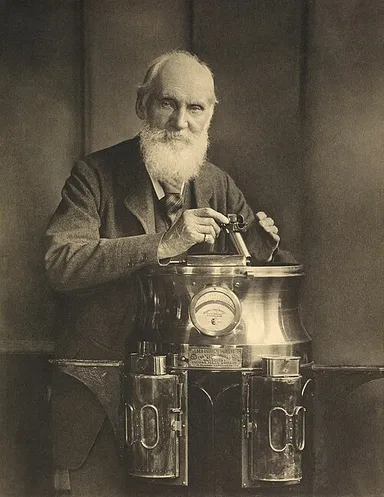
Practical systems arrived after World War II. Robert C. Webber noticed heat pouring from the outlet pipe of his deep freezer and, in the late 1940s, built the first direct-exchange ground source heat pump; accounts differ on the exact year. In 1948 the Commonwealth (Equitable) Building in Portland, Oregon, began using groundwater heat pumps for heating and cooling, the first large US commercial building to do so, now ASME National Historic Mechanical Engineering Landmark #46 (ASME).
The modern closed-loop industry grew out of the 1970s energy crises. At Oklahoma State University, Professor James Bose and colleagues developed the design methods for buried closed loops, and in 1987 Bose founded the International Ground Source Heat Pump Association (IGSHPA) on the OSU campus to train installers and set standards (National Driller). IGSHPA moved under the Geothermal Exchange Organization in 2020. Spitler (2005) summarizes how that research shaped today’s loop-sizing tools. ENERGY STAR’s current geothermal criteria took effect in 2012, and the federal 25D credit ended for systems placed in service after 2025.
| Year | Milestone | Source |
|---|---|---|
| 1852 | William Thomson (Lord Kelvin) describes the heat pump concept | IESIS |
| 1912 | Heinrich Zoelly patents using the ground as a heat pump heat source | Wikipedia |
| Late 1940s | Robert C. Webber builds the first direct-exchange ground source heat pump | Wikipedia |
| 1948 | Commonwealth Building, Portland, Oregon: first large US commercial heat pump installation | ASME |
| 1987 | IGSHPA founded at Oklahoma State University | National Driller |
| 2012 | ENERGY STAR Version 3.2 criteria take effect | ENERGY STAR |
| 2020 | IGSHPA transferred to the Geothermal Exchange Organization | National Driller |
| 2025 | Last year of the federal 25D credit (placed in service by Dec 31) | IRS |
Scientific references
- Self, S. J., Reddy, B. V., & Rosen, M. A. (2013). “Geothermal heat pump systems: Status review and comparison with other heating options.” Applied Energy, 101, 341–348. doi:10.1016/j.apenergy.2012.01.048
- Spitler, J. D. (2005). “Ground-source heat pump system research: past, present, and future” (editorial). HVAC&R Research, 11(2), 165–167. doi:10.1080/10789669.2005.10391132
- Lund, J. W., & Boyd, T. L. (2016). “Direct utilization of geothermal energy 2015 worldwide review.” Geothermics, 60, 66–93. doi:10.1016/j.geothermics.2015.11.004
- US Department of Energy (2011). Guide to Geothermal Heat Pumps. PDF
- ENERGY STAR (2012). Geothermal Heat Pumps Key Product Criteria, Version 3.2. energystar.gov
Lund and Boyd’s worldwide review shows geothermal heat pumps are the largest single category of geothermal direct use by installed capacity, which is why most people who “use geothermal” do so through a heat pump rather than a power plant.
Bottom line
A geothermal heat pump moves heat between your home and ground that sits at about 45–75°F year-round. ENERGY STAR models reach a COP of at least 3.6, and DOE says they use 25–50% less electricity than air-source heat pumps, with a ground loop that can last 50 years or more. The catch is price: roughly $15,000 to $40,000 or more installed, and no federal 25D credit for systems placed in service after December 31, 2025. It pays off best in new construction, in homes replacing propane, oil or electric resistance heat, and for owners who will stay long enough to benefit. Explore other ways to bring renewable energy into your home in our guides to renewable energy sources and the advantages of renewable energy.
FAQ
Frequently asked questions
How much does a geothermal heat pump cost?
Market data from EnergySage puts typical 2025 residential installations at about $15,000 to $40,000 or more, well above the roughly $16,000 it cites for an air-source heat pump. An older Oak Ridge National Laboratory overview gave about $3,000 to $5,000 per ton for new homes. The ground loop, especially vertical drilling, is usually the largest single cost.
Is a geothermal heat pump worth it?
It is most worth it in homes with large heating and cooling loads, high electricity or propane prices, room or geology suited to the ground loop, and owners planning to stay for many years. The ground loop can last 50 years or more, so new construction and major renovations, where trenching or drilling is easiest, usually see the best returns.
How long does a geothermal heat pump last?
DOE's Energy Saver guidance estimates up to 24 years for the indoor heat pump unit and 50 years or more for the ground loop. That means a replacement indoor unit can reuse the original loop, which makes the second system far cheaper than the first. Air-source heat pumps and furnaces typically need full replacement sooner.
Does a geothermal heat pump work in cold climates?
Yes. Because it draws heat from ground that stays around 45 to 75°F, its efficiency barely drops on cold nights. DOE's guide notes geothermal systems reach efficiencies of 300% to 600% on the coldest winter nights. Many systems in the northern US and Canada run without backup furnaces.
What is the difference between geothermal and an air-source heat pump?
Both use a refrigerant cycle to move heat rather than burn fuel. An air-source heat pump exchanges heat with outdoor air, whose temperature swings widely, so its efficiency falls on very cold or very hot days. A geothermal, or ground-source, heat pump exchanges heat with the ground or groundwater, which is stable, so it uses 25 to 50% less electricity, per DOE.
Is there still a tax credit for geothermal heat pumps?
Not federally for new installs. The IRS says the Residential Clean Energy Credit (Section 25D), which offered 30% for geothermal heat pumps, is not available for any property placed in service after December 31, 2025. Some states and utilities still offer rebates or low-interest loans for ground-source systems, so check your state energy office and utility.
How much land do you need for geothermal?
It depends on the loop type. Horizontal loops need enough open yard for long trenches, so they suit larger rural lots and new construction. Vertical loops need only a small area for a few boreholes drilled deep into the ground, so they work on suburban lots. Open loops need a well with enough water flow and a legal way to discharge it.
Can geothermal be installed in an existing home?
Yes. Retrofits are common. Vertical boreholes need only a small area, so they fit suburban lots, and existing ductwork can often be reused if it is sized for heat pump airflow. Retrofits usually cost more than new construction because the yard is landscaped and the ducts may need changes.
Do you need permits to install geothermal?
Usually. Most jurisdictions require a mechanical or building permit for the heat pump, and many states license geothermal drillers and require a well or borehole permit for vertical loops. Open-loop systems may also need approval for how the water is discharged. Your installer normally pulls the permits.
How much does geothermal cost for a 2,000 sq ft house?
Roughly $10,000 to $17,000 for a new home, using ORNL's typical figure of about 600 square feet per ton of capacity (about 3.3 tons) and $3,000 to $5,000 per ton. Retrofits and vertical drilling usually cost more, and EnergySage market data put many 2025 installs at $15,000 to $40,000 or more. Your load calculation, not floor area, sets the real size.
14 Sources
- DOE Energy Saver, Geothermal Heat Pumps (accessed October 2026)
- DOE, Guide to Geothermal Heat Pumps (2011)
- ENERGY STAR, Geothermal Heat Pumps Key Product Criteria (Version 3.2, effective Jan 1, 2012)
- IRS, Residential Clean Energy Credit
- EnergySage, Ground source heat pump cost (updated October 2025)
- Oak Ridge National Laboratory, Thermal Applications: Geothermal Heat Pumps
- ASME Landmark #46, Commonwealth Building Heat Pump (1948)
- Pearson, A. (2020), IESIS paper on Scotland's role in heat pump development (Kelvin 1852)
- Wikipedia, Ground source heat pump (history: Zoelly 1912, Webber 1940s)
- National Driller, OSU to continue IGSHPA geothermal training and certification
- Self, Reddy and Rosen (2013), Applied Energy
- Spitler (2005), HVAC&R Research
- Lund and Boyd (2016), Geothermics
- EIA, Electric Power Monthly Table 5.6.A (August 2026 data)
Published October 25, 2026 · updated October 25, 2026 by Izhar Ahmad Danish. Part of our renewable energy guide. Found an error? Tell us.