Quick answer
To lower your electric bill, start with the biggest loads. Air conditioning, space heating and water heating used 43% of US home electricity in 2020 (EIA). Setting the thermostat back 7 to 10°F for 8 hours a day can save up to 10% a year on heating and cooling (DOE). Then switch to LEDs, cut standby power and check your rate plan.
Key facts
- 19%: air conditioning's share of US home electricity, the largest single end use (EIA, RECS 2020)
- 12% + 12%: space heating and water heating, the next two largest (EIA, RECS 2020)
- Up to 10%: yearly heating and cooling savings from a 7 to 10°F setback for 8 hours a day (DOE)
- 5% to 10%: share of residential electricity drawn by devices on standby (Berkeley Lab)
- At least 75%: how much less energy ENERGY STAR LED bulbs use than incandescents (DOE)
On this page
- Why is my electric bill so high?
- What uses the most electricity in a house?
- How to lower your electric bill: heating and cooling
- How to save on water heating
- How to cut lighting, appliance and standby costs
- How to pay less for the electricity you do use
- How much can you save in a year? A worked example
- Can solar panels lower your electric bill?
- History of home energy saving
- Scientific references
- Bottom line
- Frequently asked questions
The cheapest kilowatt-hour is the one you never use. The average US residential customer used 865 kWh a month in 2024 (EIA), and the average residential price was 18.16 cents per kWh in August 2026 (EIA Electric Power Monthly). That works out to about $157 a month in energy charges before fixed fees. This guide shows you how to lower your electric bill by going after the loads that actually matter, with the savings for each tip worked out in dollars, not vague promises. To price your own appliances as you read, keep the electricity cost calculator open in another tab.
Why is my electric bill so high?
Before changing anything, find out whether you are using more electricity or paying more for it. Your bill shows both numbers: total kWh and the price per kWh (or the energy charge divided by kWh).
- kWh went up, price flat: something in the house is using more. Weather is the most common reason, followed by a new appliance (space heater, EV charger, pool pump, second fridge), more people at home, or failing equipment such as an air conditioner low on refrigerant.
- kWh flat, bill up: your rate changed. Seasonal rates, a new rate plan or a utility price increase are the usual causes.
- A sudden jump in one month: check whether the reading was estimated. An estimated bill followed by an actual reading can make one month look far higher than it really was.
Compare against the same month last year, not last month, because heating and cooling swing usage with the seasons. If you want to see what a single device adds, multiply its watts by hours of use and divide by 1,000 to get kWh, or use the electricity usage calculator.
What uses the most electricity in a house?
According to the EIA’s Residential Energy Consumption Survey, the three largest uses of electricity in US homes in 2020 were:
| End use | Share of home electricity (2020) |
|---|---|
| Air conditioning | 19% |
| Space heating | 12% |
| Water heating | 12% |
| Lighting and refrigerators | next largest (EIA gives no single figure on this page) |
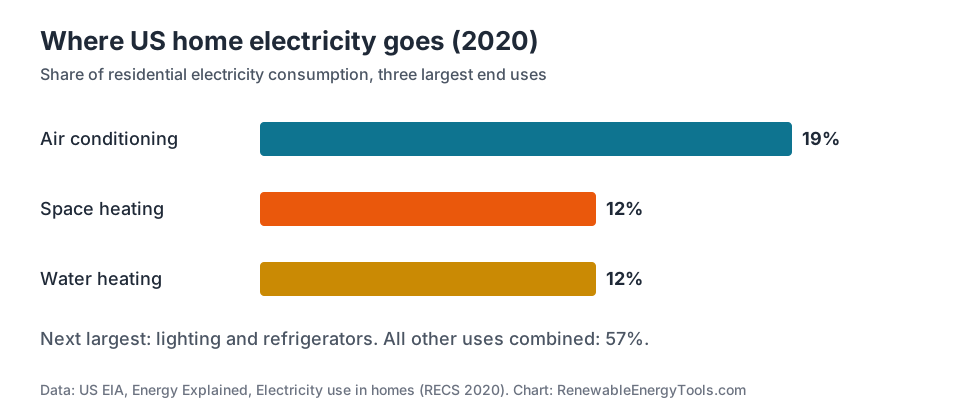
Together, heating, cooling and hot water make up 43% of the total. That is why turning off lights, though worth doing, rarely moves a bill much on its own. The order of attack is simple: heating and cooling first, water heating second, then lighting, appliances and standby power. The EIA also puts the average US household at about 10,500 kWh a year, which is the baseline used in the examples below. Your mix will differ: a home with gas heat and gas hot water spends much less of its electricity on those uses, and a home in Florida spends far more on cooling than one in Maine. For a refresher on the units, see what is a kilowatt-hour.
How to lower your electric bill: heating and cooling
1. Set back the thermostat
The DOE’s Energy Saver guidance says you can save as much as 10% a year on heating and cooling by turning your thermostat back 7 to 10°F from its normal setting for 8 hours a day, for example while you sleep or are at work. In winter that means lower; in summer, higher. The DOE notes the percentage saving is greater in milder climates.
What is that worth? Using the EIA averages, air conditioning plus space heating is 31% of 10,500 kWh, or 3,255 kWh a year. Ten percent of that is about 326 kWh, which is roughly $59 a year at 18.16 cents per kWh. In an all-electric home in a hot or cold climate, the figure is larger.
2. Let a programmable or smart thermostat do it
A setback only saves money if it happens every day. A programmable or smart thermostat applies the schedule automatically, so you do not have to remember. Program it once, then leave it; constantly overriding the schedule removes the saving.
3. Keep filters clean and air moving
A clogged air filter makes the blower and compressor work harder. Check filters monthly during heavy-use seasons and replace them when dirty. Keep supply and return vents clear of furniture and curtains.
4. Use fans and shade in summer
Ceiling fans cool people, not rooms, so turn them off when you leave. In summer, close blinds on sun-facing windows during the hottest hours to keep solar heat out, which reduces how long the air conditioner runs.
5. Seal air leaks and add insulation
Gaps around doors, windows, attic hatches and plumbing penetrations let conditioned air escape. Weatherstripping and caulk are among the cheapest upgrades in a home. For a full picture, a professional home energy audit with a blower-door test shows exactly where air is leaking.
6. Be careful with space heaters
A space heater can make one room comfortable, but it is expensive heat. A 1,500 watt heater running 4 hours a day uses 6 kWh, about $1.09 a day or $33 a month at 18.16 cents per kWh. It saves money only if it lets you keep the rest of the house much cooler.
How to save on water heating
7. Lower the water heater temperature and use less hot water
Water heating is 12% of home electricity in the EIA data. Lowering the tank setpoint, fixing dripping hot taps, fitting low-flow showerheads and washing clothes in cold water all cut the energy the tank has to replace.
8. Consider a heat pump water heater
When an electric tank needs replacing, a heat pump water heater is the biggest single upgrade. The DOE says heat pump water heaters can be two to three times more energy efficient than conventional electric resistance water heaters, because they move heat from the surrounding air instead of generating it.
As an illustration only: 12% of an average 10,500 kWh year is 1,260 kWh. If that were all electric resistance heating, using a third to a half as much electricity would save about 630 to 840 kWh, or $114 to $153 a year at 18.16 cents per kWh. Homes that heat water with gas will not see this saving on their electric bill.
How to cut lighting, appliance and standby costs
9. Switch to LED bulbs
The DOE says ENERGY STAR LED bulbs use at least 75% less energy and last up to 25 times longer than incandescent lighting. Replacing a 60 watt incandescent with a 9 watt LED that runs 3 hours a day saves 51 W × 3 h × 365 days = 55.8 kWh a year, about $10.14 per bulb per year. Start with the bulbs you use most.
10. Cut standby (phantom) power
Phantom power, also called vampire power, is electricity drawn by devices that are switched off or idle but still plugged in: TVs, game consoles, chargers, set-top boxes and anything with a clock or remote. Lawrence Berkeley National Laboratory, a DOE national lab, estimates that standby loads add up to 5% to 10% of residential electricity use.
Small loads add up because they run all year. A steady 50 watt standby load uses 50 W × 8,760 hours = 438 kWh a year, about $79.54 at 18.16 cents per kWh. A smart power strip that switches off peripherals when the TV or computer is off is the easiest fix. A plug-in energy meter shows exactly what each device draws when “off”.
11. Retire the second fridge
The EIA estimated in 2020 that a home’s most-used refrigerator cost about $87 a year to run, a second refrigerator about $66 and a separate freezer about $74. The EIA also found that 34% of US homes had two or more refrigerators. If the garage fridge is mostly empty, unplugging it is an easy saving.
12. Run full loads and air-dry when you can
Dishwashers and washing machines use about the same energy whether they are full or half empty, so run full loads. Clothes dryers are among the bigger appliance loads; air-drying or using a dryer’s moisture-sensor setting instead of a fixed timer reduces run time.
13. Buy ENERGY STAR when you replace
When an appliance needs replacing, compare the yellow EnergyGuide label’s estimated yearly kWh. ENERGY STAR certified models are independently certified to be more efficient than standard models. Replacing working equipment early rarely pays back; replacing failed equipment with an efficient model almost always does.
How to pay less for the electricity you do use
14. Check your rate plan
Many utilities offer time-of-use plans, where electricity costs less at off-peak times. On such a plan, shifting dishwashers, laundry and especially EV charging to off-peak hours lowers the bill without using less energy. On a flat rate, timing makes no difference. Use the cost per kWh calculator to work out what you actually pay per kWh, including fixed charges. If you charge an electric car, see the cost to charge an electric car.
15. Track your usage
Many US utilities let you download your usage data, often through the Green Button format. Seeing daily or hourly use makes it easy to spot a load that never switches off. Research backs this up: studies of home energy reports and real-time feedback, reviewed in the references below, found that households given information about their own use, or compared with their neighbours, used less electricity.
How much can you save in a year? A worked example
Combining four of the measures above saves roughly $190 to $340 a year for a typical home at the US average rate, or about 10% to 18% of a $157 monthly bill.
The figures below reuse the examples from this guide, all at 18.16 cents per kWh. Your own numbers will differ with your rate, climate and equipment, so treat this as a template rather than a promise.
| Measure | Example | Yearly saving |
|---|---|---|
| Thermostat setback | 10% of 3,255 kWh heating and cooling | about $59 |
| LED bulbs (example: 5 bulbs) | 5 bulbs, 51 W saved each, 3 hours a day | about $51 |
| Standby power | 50 W of always-on loads switched off | about $80 |
| Subtotal (no-cost and low-cost steps) | about $190 | |
| Heat pump water heater | 630 to 840 kWh saved | $114 to $153 |
| Total with the water heater upgrade | about $300 to $340 |
Against a $157 monthly bill, which is $1,884 a year, the low-cost steps cut about 10% and the full list about 18% (our arithmetic). The order matters: do the free and cheap measures first, then use the electricity usage calculator to find what is left before you spend money on equipment.
Can solar panels lower your electric bill?
Yes, once you have cut waste first. Every kWh you save is a kWh you do not need to generate, so efficiency makes any solar energy system smaller and cheaper. Renters and apartment dwellers may be able to use small balcony systems where the rules allow; see our guide to plug-in solar laws. For whole-house heating and cooling efficiency, a geothermal heat pump is the long-term upgrade.
History of home energy saving
Saving electricity at home became a national policy topic after the energy crises of the 1970s. The EIA’s Residential Energy Consumption Survey, the source of the end-use shares on this page, has tracked how US homes use energy across many survey years since then, giving households and policymakers a shared picture of where electricity goes.
The EPA launched the voluntary ENERGY STAR program in 1992 to help buyers identify efficient products, and the blue label now appears on appliances, electronics, lighting and heating and cooling equipment. Data access followed: the Green Button initiative gave utility customers a standard way to download their own usage data. Today smart meters, smart thermostats and time-of-use rates let households see and shift their use hour by hour.
Scientific references
- Allcott, H. (2011). Social norms and energy conservation. Journal of Public Economics, 95(9–10), 1082–1095. doi:10.1016/j.jpubeco.2011.03.003
- Faruqui, A., Sergici, S., & Sharif, A. (2010). The impact of informational feedback on energy consumption: A survey of the experimental evidence. Energy, 35(4), 1598–1608. doi:10.1016/j.energy.2009.07.042
- US Energy Information Administration. Residential Energy Consumption Survey (RECS), 2020 survey. EIA RECS
Bottom line
To lower your electric bill, target the big three first: air conditioning, space heating and water heating used 43% of US home electricity in 2020. A thermostat setback is free and can cut heating and cooling costs by up to 10%. A heat pump water heater, LEDs and cutting standby power come next, and a time-of-use plan can lower what you pay per kWh. Measure before and after with the kWh calculator and electricity cost calculator, and once your use is lean, cover what is left with renewable energy.
FAQ
Frequently asked questions
What is the fastest way to lower my electric bill?
Change how you heat and cool first, because air conditioning and space heating together used 31% of US home electricity in 2020 (EIA). Setting the thermostat back 7 to 10°F for 8 hours a day can cut heating and cooling costs by up to 10% a year, according to the DOE. It costs nothing and starts on your next bill.
What uses the most electricity in a house?
Air conditioning is the largest single use, at 19% of US residential electricity in 2020, followed by space heating and water heating at 12% each, according to the EIA's Residential Energy Consumption Survey. Lighting and refrigerators are the next largest. Your own mix depends on climate and on whether your heat and hot water are electric.
Does unplugging appliances save electricity?
Yes, a little. Lawrence Berkeley National Laboratory estimates that devices on standby account for 5% to 10% of residential electricity use. A steady 50 watt standby load uses 438 kWh a year, about $80 at the August 2026 US average of 18.16 cents per kWh. Smart power strips make cutting it easy for TV and computer setups.
Why is my electric bill so high all of a sudden?
The usual causes are weather (more heating or cooling), a rate increase, a new appliance such as a space heater or EV charger, more people at home, or an estimated meter reading. Compare kWh, not dollars, with the same month last year. If kWh is flat, your price changed; if kWh rose, look for a new or failing load.
Is it cheaper to run appliances at night?
Only if you are on a time-of-use or similar rate plan, where electricity costs less in off-peak hours. On a flat rate every kWh costs the same whenever you use it. Check your bill or your utility's rate page; if a time-of-use plan is offered, shifting dishwashers, laundry and EV charging can cut costs.
Do LED bulbs really save money?
Yes. The DOE says ENERGY STAR LEDs use at least 75% less energy and last up to 25 times longer than incandescent bulbs. Replacing a 60 watt bulb with a 9 watt LED used 3 hours a day saves about 56 kWh a year, roughly $10 at 18.16 cents per kWh, for each bulb.
Does turning the thermostat down at night save money?
Yes. The DOE says turning your thermostat back 7 to 10°F from its normal setting for 8 hours a day can save as much as 10% a year on heating and cooling. The savings are larger in milder climates. A programmable or smart thermostat makes the setback automatic.
How much does a second refrigerator cost to run?
The EIA estimated that a second refrigerator cost about $66 a year to run in 2020, and a separate freezer about $74. If an old garage fridge holds only a few drinks, unplugging or recycling it is one of the simplest savings in the house.
Can you cut your electric bill in half?
Rarely with efficiency tips alone. In this guide's worked example, four common measures cut a typical $157 monthly bill by about 10% to 18%. Bigger cuts usually need larger changes, such as replacing electric resistance heating, moving to a cheaper rate plan or adding solar panels, so claims of 75% or 90% savings from one gadget deserve skepticism.
12 Sources
- EIA, Energy Explained: Electricity use in homes (RECS 2020 end uses)
- EIA, Electric Power Monthly Table 5.6.A, August 2026 residential prices
- EIA, Today in Energy: residential electricity use and bills in 2024
- EIA, Residential Energy Consumption Survey (RECS)
- US DOE Energy Saver, Programmable thermostats (archived copy, Dec 2024)
- US DOE Energy Saver, LED lighting (archived copy, Jan 2026)
- Lawrence Berkeley National Laboratory, Standby Power
- US DOE Energy Saver, Heat pump water heaters (archived copy, Jun 2026)
- ENERGY STAR, About ENERGY STAR (history)
- US DOE, Green Button
- Allcott (2011), Social norms and energy conservation, Journal of Public Economics
- Faruqui, Sergici & Sharif (2010), The impact of informational feedback on energy consumption, Energy
Published October 25, 2026 · updated October 25, 2026 by Izhar Ahmad Danish. Part of our renewable energy guide. Found an error? Tell us.