Quick answer
As of October 25, 2026, ten US states have enacted plug-in (balcony) solar laws: Utah, Virginia, Maine, Colorado, Maryland, Connecticut, Vermont, New Hampshire, New Jersey and California. Most cap a system at 1,200 watts per meter or household. They also exempt it from utility interconnection agreements and fees and exclude it from net metering. Everywhere else, your utility's interconnection rules still apply.
Key facts
- 10 states had enacted plug-in solar laws as of October 25, 2026; New York's SUNNY Act passed but awaits the governor.
- 1,200 W: the usual cap (Utah, Virginia, Vermont, New Jersey, California); Colorado allows up to 1,920 W per address.
- May 7, 2025: Utah HB 340 took effect, the first US state law exempting plug-in solar from interconnection.
- 391 W: Virginia, Colorado and Maryland relax listing or installation rules for very small devices.
- UL 3700: the safety standard for plug-in PV named in Vermont's Act 149 and Maine's law.
On this page
- Is plug-in solar legal in the US?
- Plug-in solar laws by state (table)
- What does Utah’s HB 340 say?
- What does Virginia’s plug-in solar law require?
- Which state allows the biggest plug-in system?
- Do you need permission from your landlord or HOA?
- Do you have to notify your utility?
- How much can a 1,200 W plug-in solar system save?
- Is balcony solar safe?
- History of plug-in solar laws
- Standards and references
- Bottom line
- Frequently asked questions
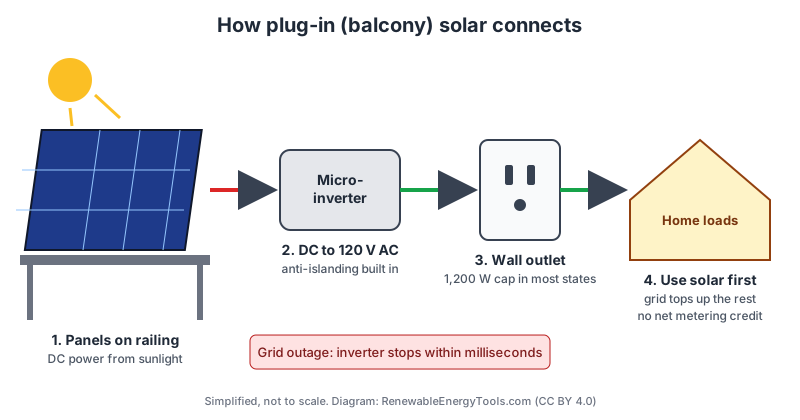
Plug-in solar, also called balcony solar, is a small solar kit (usually one to four panels and a microinverter) that you plug into an ordinary wall outlet. Germany has millions of them. In the US they sat in a legal grey zone until 2025, because most utility rules treat any grid-connected generator as needing an interconnection agreement. That is changing fast. This guide lists every state with a plug-in solar law, what each one allows, and what to check before you buy a kit. It also covers the main safety issues.
Status checked: October 25, 2026. We read each law in the state legislature’s own text wherever it could be retrieved, and the table notes where a detail rests on news coverage instead. Laws are changing month to month, so check your state’s legislature site before you install.
Is plug-in solar legal in the US?
As of October 25, 2026, plug-in solar is expressly legal in ten states: Utah, Virginia, Maine, Colorado, Maryland, Connecticut, Vermont, New Hampshire, New Jersey and California. In those states a qualifying system is exempt from utility interconnection agreements and fees. In the other 40 states and DC there is no federal ban, but your utility’s interconnection tariff still applies. Plugging in a generator without permission can breach your service terms, and some insurers may question a claim.
The laws share a common template, first written into Utah’s 2025 statute:
- A size cap, usually 1,200 watts. That is 80% of a 15-amp, 120-volt circuit, the continuous-load limit in the National Electrical Code.
- Anti-islanding. The device must stop sending power to the building during a grid outage, so line workers and the plug’s pins are never live.
- No utility approval, fees or extra equipment for a compliant device.
- No net metering. The power offsets what your home uses at that moment, and any surplus earns nothing.
Plug-in solar laws by state (table)
| State | Law | Status / effective | Size cap | Notable rules |
|---|---|---|---|---|
| Utah | HB 340 (2025), Solar Power Amendments | In effect since May 7, 2025 | 1,200 W, 120 V outlet | First state law; no approval, fees or added equipment; excluded from net metering; no renter or HOA protection |
| Virginia | HB 395 (2026), Ch. 1052 | Approved Apr 22, 2026; in effect Jan 1, 2027 | 1,200 W per customer or unit | Notice on SCC form, 15-day utility review; landlords with more than 4 units cannot ban; localities cannot prohibit; ≤391 W exempt from rewiring listing rules |
| Maine | LD 1730 (2026) | Signed Apr 6, 2026; in effect mid-July 2026 | 420 W self-install; up to 1,200 W with electrician* | UL 3700 referenced; utility notice within 30 days above 420 W*; renters covered |
| Colorado | HB26-1007, Ch. 127 | Signed May 7, 2026; law effective Aug 12, 2026; device and HOA rules Jan 1, 2027 | 1,920 W per address | NRTL-listed; HOA bans void from 2027; no unlisted devices over 391 W sold from 2027; meter-collar adapter rules due by end of 2026 |
| Maryland | HB 1532, Utility RELIEF Act | Signed May 12, 2026 | 1,200 W per meter* | ≤391 W exempt from UL listing*; no pre-approval or interconnection fee* |
| Connecticut | HB 5340 (2026 omnibus energy act) | Signed Jun 4, 2026; plug-in provisions Oct 1, 2026 | 1,200 W* | Utility approval waived* |
| Vermont | S.202, Act 149 | Signed Jun 16, 2026; in effect Jul 1, 2026 | 1,200 W combined inverter capacity per meter | UL 3700 + IEEE 1547-2018; smart meter required; no fees or approval; tenants give 10 days’ notice; zoning and covenant bans barred |
| New Hampshire | SB 540 (2026) | Signed early July 2026; in effect Jan 1, 2027* | 1,200 W AC per meter | Exempt from interconnection and net metering |
| New Jersey | S2368/A4836, Garden State Balcony Solar Act | Signed Sep 1, 2026; in effect Mar 1, 2027* | 1,200 W | Landlords, HOAs and municipalities cannot broadly ban; no municipal permits |
| California | SB 868, Plug and Play Solar Act | Signed Sep 30, 2026; in effect Jan 1, 2027 | 1,200 W per household | Online registration instead of interconnection; must meet state and national electrical codes |
| New York | SUNNY Act, S8512C/A9111C | Passed legislature May 2026; not signed as of Oct 25, 2026 | 1,200 W AC | 30-day utility notice; no explicit landlord/HOA protection |
*Detail from news coverage (pv magazine USA, New Hampshire Bulletin) rather than the enacted text, which we could not retrieve; confirm on the legislature site. Utah, Virginia, Vermont, Colorado and New Jersey details are from legislative texts or official releases listed in the sources.
Bills were also moving in Massachusetts, Illinois, Oklahoma, Hawaii, Rhode Island, Pennsylvania and other states in 2026. Washington’s 2026 bills failed.
What does Utah’s HB 340 say?
Utah’s HB 340 defines a “portable solar generation device” as a moveable PV device of no more than 1,200 watts that plugs into a standard 120-volt outlet to offset part of the customer’s own use, and exempts it from interconnection and net metering rules. It took effect on May 7, 2025, after passing the House 72–0 and the Senate 27–0 (pv magazine USA).
The new Utah Code section 54-15-601 has three parts. It requires a feature that stops the device from energizing the building during an outage. It bars the utility from requiring approval, fees or extra controls. It also shields the utility from liability for damage the device causes (Vermont Office of Legislative Counsel summary). The statute says nothing about landlords or HOAs, so a lease or covenant can still forbid a kit.
What does Virginia’s plug-in solar law require?
Virginia’s HB 395 lets any customer run a “small portable solar generation device” of up to 1,200 watts per customer or apartment, starting January 1, 2027. You must first file a State Corporation Commission notice form with your utility. If the utility does not respond within 15 days, you may install.
The device must meet the latest National Electrical Code, be certified by a Nationally Recognized Testing Laboratory (NRTL) under 29 CFR 1910.7, and include outage protection. Devices of 391 watts or less are exempt from product-listing provisions that would force rewiring. Virginia goes further than Utah on housing:
- Landlords who own more than four rental units cannot ban a device on the exterior of a tenant’s premises. They may set reasonable size and placement rules. Tenants must give seven days’ notice with proof the device complies.
- Localities cannot prohibit devices on homes that meet zoning height, setback and historic-district rules (Va. Code §15.2-2288.7).
- Exceptions: units billed through a ratio utility billing system (RUBS) are excluded. If several devices are on one property, the utility may install a locking disconnect switch.
Which state allows the biggest plug-in system?
Colorado: HB26-1007 allows a “portable-scale solar generation device” of up to 1,920 watts per address, the highest cap in the US. The device must be labeled and listed by an NRTL and must not energize the grid during an outage (Colorado General Assembly).
Governor Polis signed it on May 7, 2026 (Chapter 127). Key dates:
- January 1, 2027: sale, lease or rental of unlisted devices over 391 watts is banned. HOA covenants that unreasonably prohibit the devices become void.
- December 31, 2026: deadline for the PUC to revise interconnection rules so customers can use meter collar adapters. These plug a larger solar or battery system in at the meter rather than at an outlet.
Utilities may ask customers to report the device’s presence and size but cannot require pre-approval.
Do you need permission from your landlord or HOA?
It depends on the state: Virginia, Vermont, Colorado (from 2027) and New Jersey limit landlord or HOA bans, while Utah’s law does not address them. Even where a ban is barred, owners can usually set reasonable rules on size, placement and secure mounting.
Vermont’s Act 149 has the most detail (enacted text). A tenant must give at least 10 days’ notice. The landlord may respond with reasonable restrictions, such as requiring a licensed electrician at the tenant’s cost, and if the landlord stays silent the tenant may proceed. Vermont also amended its deed-restriction law so covenants cannot ban plug-in devices, even on condo patio railings. New Jersey’s governor said the act prevents landlords, HOAs and similar entities from broadly banning the devices and bars municipalities from requiring permits (NJ Governor).
Do you have to notify your utility?
Utah and Vermont say the utility cannot require approval. Virginia, Maine (above 420 W), California and New York’s pending bill use a notice or registration instead, and Colorado lets utilities ask for the device size. None of the enacted laws allow a utility to charge an interconnection fee for a compliant device.
Notice matters because utilities plan circuits around expected load. It is also why several laws, such as Vermont’s, require a smart meter: an older spinning meter could run backwards when the kit exports a little power, which would amount to unauthorized net metering. A rooftop system, by contrast, still goes through the full solar panel installation permit and interconnection process.
How much can a 1,200 W plug-in solar system save?
A 1,200-watt kit produces roughly 1,300 to 1,900 kWh a year in most of the US, worth about $240 to $350 at the US average residential price of about 18.2 cents per kWh. That holds only if your home uses the power as it is made. The figures are illustrative, not survey data.
Illustrative savings (assumptions, not survey data)
1,200 W of panels × 4.0 peak sun hours × 365 days × 0.85 system efficiency ≈ 1,490 kWh a year. At 18.2¢/kWh (EIA average residential price, August 2026, Table 5.6.A) that is about $271. A balcony kit facing east or west, or shaded part of the day, can make half that. Exported surplus earns nothing because plug-in systems are excluded from net metering.
Run your own numbers with our solar panel calculator and convert watt ratings with the watts to kWh converter. The best match is a kit sized to your daytime baseload: a refrigerator, router, freezer and standby loads often draw 150–400 W around the clock. Our electricity cost calculator shows what each of those loads costs.
Is balcony solar safe?
A certified plug-in system is designed to be safe on a normal household circuit, provided it stays within the 1,200 W cap, has working anti-islanding, and is not plugged into an overloaded circuit or a power strip. Safety standards are the reason most laws require NRTL listing.
The two engineering concerns are:
- Live plug pins. A male plug carrying power would be a shock hazard. Microinverters meet IEEE 1547 and UL 1741 grid rules, which require them to shut off within a fraction of a second once they lose grid voltage. UL 3700, the newer standard named in Vermont’s law, tests the whole plug-in kit.
- Circuit overload. A breaker measures only grid current. Solar injected at an outlet can let downstream wiring carry the breaker rating plus the solar output. Keeping kits small and on a dedicated or lightly loaded circuit limits this risk. Some local electrical inspectors, such as Dover, New Hampshire’s, have urged caution until state safety standards are finalized.
For safe use, buy a listed kit and plug it directly into a grounded outdoor GFCI outlet, not an extension cord. Secure the panels against wind (Vermont’s law requires “temporarily but securely” attached), and don’t add a second kit on the same circuit.
History of plug-in solar laws
Plug-in solar grew up in Europe. Germany’s “Balkonkraftwerk” market expanded in the late 2010s and early 2020s, and Germany’s 2024 Solar Package raised its simplified limit to 800 W of inverter output. US interest followed as panel prices fell, but American utilities treated any parallel generator as needing an interconnection agreement.
Utah broke that pattern in 2025, when HB 340 passed both chambers unanimously and took effect on May 7. Virginia, whose bill was modeled on Utah’s, came next in April 2026, followed by Maine the same month. A wave of 2026 laws followed: Colorado and Maryland in May, Connecticut and Vermont in June, New Hampshire in July, New Jersey in September, and California on September 30. In one legislative season the US went from one plug-in solar state to ten.
| Date | Milestone | Source |
|---|---|---|
| May 7, 2025 | Utah HB 340 takes effect, the first US plug-in solar law | Utah Legislature |
| Apr 6, 2026 | Maine LD 1730 signed | Maine Senate |
| Apr 22, 2026 | Virginia HB 395 approved (Ch. 1052) | Virginia LIS |
| May 7, 2026 | Colorado HB26-1007 signed, 1,920 W cap | Colorado GA |
| May 12, 2026 | Maryland HB 1532 signed | pv magazine USA |
| Jun 16, 2026 | Vermont Act 149 signed; effective July 1 | Vermont Legislature |
| Sep 1, 2026 | New Jersey Garden State Balcony Solar Act signed | NJ Governor |
| Sep 30, 2026 | California SB 868 signed; effective Jan 1, 2027 | pv magazine USA |
Standards and references
- Utah Code §54-15-601, Portable solar generation device (H.B. 340, 2025).
- Code of Virginia §56-596.7, §55.1-1212.1 and §15.2-2288.7 (HB 395, 2026, Ch. 1052).
- 30 V.S.A. §256, Plug-in photovoltaic devices (Vermont Act 149, 2026).
- UL 3700, Outline of Investigation for Plug-In Photovoltaic Systems, UL Solutions.
- IEEE 1547-2018, Standard for Interconnection and Interoperability of Distributed Energy Resources. doi:10.1109/IEEESTD.2018.8332112
Bottom line
Plug-in solar is now expressly legal in ten US states. Utah has allowed it since May 2025, Vermont, Maine and Connecticut since mid-2026, and Virginia, New Hampshire, California and (by March) New Jersey by early 2027. Colorado’s law is in effect, with its device rules starting January 1, 2027. Expect a 1,200 W cap (1,920 W in Colorado), no interconnection fees, no net metering, and either no paperwork or a simple notice. Renters have the strongest protections in Virginia, Vermont, Colorado and New Jersey. A kit saves the most when it is sized to your daytime baseload. For a full rooftop or battery system, see our off-grid solar system guide and how solar panels work. For more on going renewable at home, start at renewable energy.
FAQ
Frequently asked questions
Is plug-in solar legal in the US?
It depends on the state. As of October 25, 2026, ten states have laws that let you plug a small solar system into a standard outlet without an interconnection agreement: Utah, Virginia, Maine, Colorado, Maryland, Connecticut, Vermont, New Hampshire, New Jersey and California. Elsewhere there is no federal ban, but your utility's interconnection rules apply, and connecting without approval can breach your service terms.
Is balcony solar legal in California?
Yes, from January 1, 2027. Governor Newsom signed SB 868, the Plug and Play Solar Act by Senator Scott Wiener, on September 30, 2026. It allows certified systems of up to 1,200 watts per household that plug into a standard outlet, with a simple registration instead of a utility interconnection agreement.
How many watts can a plug-in solar system be?
Most state laws cap it at 1,200 watts, which is the safe continuous load on a common 15-amp, 120-volt circuit. Colorado's HB26-1007 is the exception at 1,920 watts per address. Maine lets residents self-install up to 420 watts and requires an electrician for larger systems up to 1,200 watts.
Do I have to tell my utility about balcony solar?
Sometimes. Utah and Vermont bar utilities from requiring approval. Virginia requires a notice on a State Corporation Commission form before installing, and the utility has 15 days to respond. Maine requires notice within 30 days for systems over 420 watts. California uses an online registration, and Colorado lets utilities ask you to report the device's size.
Can my landlord or HOA ban plug-in solar?
In some states, no. Virginia bars landlords with more than four units from banning devices on a tenant's exterior space, subject to reasonable rules and seven days' notice. Vermont requires ten days' notice and voids covenant bans. Colorado voids unreasonable HOA bans from January 1, 2027, and New Jersey bars broad landlord, HOA and municipal bans. Utah's law has no renter protection.
Does plug-in solar get net metering?
No. Utah, Virginia and Vermont all exclude plug-in devices from net metering, and Vermont says exported power is not compensated. A plug-in system saves money only when your home uses the power as it is produced, so size it to your daytime baseload.
What is UL 3700?
UL 3700 is UL Solutions' safety outline for plug-in photovoltaic systems. It covers protection against shock at the plug and safe behavior on household circuits. Vermont's Act 149 requires UL 3700 or an equivalent certification from a Nationally Recognized Testing Laboratory, and Maine's law references it too.
Is the New York SUNNY Act law yet?
Not as of October 25, 2026. The Solar Up Now NY (SUNNY) Act, S8512C/A9111C, passed both chambers in May 2026 for devices up to 1,200 watts, but Governor Hochul had not signed it. Check the governor's bill actions before buying a kit for a New York home.
16 Sources
- Vermont Act 149 (S.202) as enacted, signed June 16, 2026
- Vermont Office of Legislative Counsel, Portable solar laws in Virginia and Utah (March 2026)
- Utah Legislature, H.B. 340 Solar Power Amendments (2025), enrolled
- Virginia LIS, HB 395 (2026 session)
- Colorado General Assembly, HB26-1007
- Colorado HB26-1007 rerevised text (second-house amendments)
- Office of the Governor of New Jersey, Garden State Balcony Solar Act signing (Sept 1, 2026)
- Maine Senate Democrats, Sen. Grohoski on LD 1730 (April 2026)
- Connecticut General Assembly, HB 5340 (2026) bill summary
- pv magazine USA, Newsom signs California plug-in solar bill (Oct 1, 2026)
- pv magazine USA, Maine's plug-in solar law (April 2026)
- pv magazine USA, Maryland and Colorado plug-in provisions pass (April 2026)
- pv magazine USA, New York legislature passes SUNNY Act (June 2026)
- New Hampshire Bulletin, NH joins states with plug-in solar laws (July 2026)
- pv magazine USA, Utah balcony solar bill (March 2025)
- EIA, Electric Power Monthly Table 5.6.A
Published October 25, 2026 · updated October 25, 2026 by Izhar Ahmad Danish. Part of our renewable energy guide. Found an error? Tell us.