Quick answer
A photovoltaic (PV) cell is a semiconductor device, usually silicon, that turns sunlight directly into electricity. Photons free electrons, and a built-in electric field at the cell's p-n junction pushes them into a circuit as direct current. The best certified silicon-perovskite tandem cell reached 34.85% efficiency in 2025 (LONGi, NREL-certified).
Key facts
- 34.85%: record efficiency for a perovskite-on-silicon tandem cell, certified by NREL in 2025 (LONGi).
- 27.81%: record for a single-junction silicon cell (LONGi HIBC, certified by ISFH, 2025).
- 47.6%: the four-junction concentrator cell record from Fraunhofer ISE, at 665 suns (2022).
- 33.7%: the Shockley-Queisser limit for a single-junction cell.
- 1976: the start of NREL's Best Research-Cell Efficiency Chart, which tracks records across PV technologies.
On this page
- What is a photovoltaic cell?
- How does a photovoltaic cell work?
- What are the types of solar cells?
- How efficient are photovoltaic cells?
- What are the parts of a solar panel system?
- How do solar panels produce electricity for your home?
- What reduces solar panel performance?
- What are solar panels made of, and how are they made?
- History of the photovoltaic cell
- Scientific references
- Bottom line
- Frequently asked questions
Every solar panel is built from photovoltaic cells, thin slices of semiconductor that turn light into electricity with no moving parts, no fuel and no noise. Understanding how a PV cell works makes it easier to compare panels, read a datasheet and size a system. This guide walks through the photovoltaic effect step by step, the main cell types from monocrystalline to perovskite, current efficiency records and the components of a home solar system. For the bigger picture, see our renewable energy homepage and the solar energy guide.
What is a photovoltaic cell?
A photovoltaic (PV) cell, or solar cell, is a semiconductor device that converts sunlight directly into direct-current electricity through the photovoltaic effect. Most commercial cells are made of crystalline silicon about the thickness of a few sheets of paper.
The word “photovoltaic” joins “photo” (light) and “volt” (the unit of electrical potential). A single cell produces only a fraction of a volt, so manufacturers wire dozens of cells together into a module, or solar panel, and seal them behind tempered glass in an aluminum frame.
Key terms used in this guide:
- Semiconductor: a material, like silicon, whose ability to conduct electricity sits between a metal and an insulator and can be controlled by adding impurities.
- Doping: adding small amounts of other elements to silicon. Phosphorus adds spare electrons (n-type); boron creates “holes,” or missing electrons (p-type).
- P-n junction: the boundary where n-type and p-type silicon meet, which creates a built-in electric field.
- Band gap: the minimum energy a photon must carry to free an electron. Silicon’s band gap suits much of the sunlight spectrum.
How does a photovoltaic cell work?
A PV cell works by letting photons knock electrons loose in a semiconductor, then using the electric field at a p-n junction to push those electrons through an external circuit. The flow of electrons is the electric current.
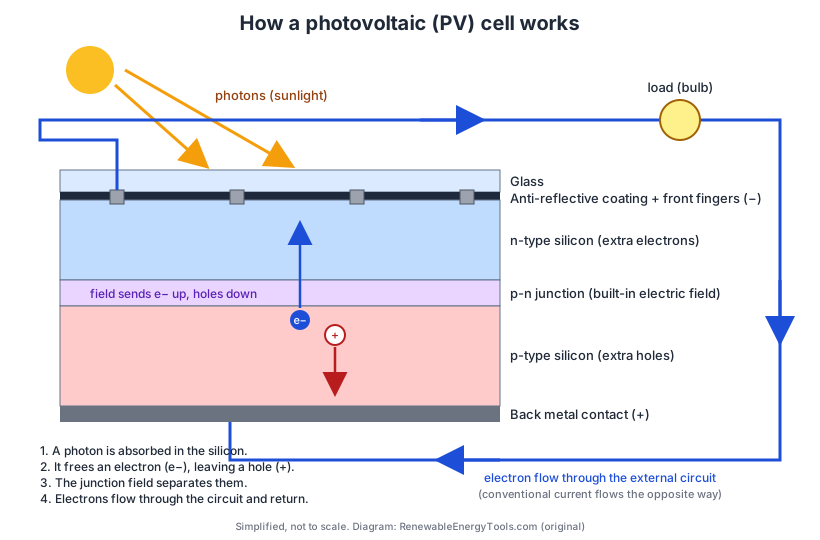
The photovoltaic effect, step by step:
- Light arrives. Sunlight, a stream of photons, passes through the glass and an anti-reflective coating that helps the cell absorb more light.
- Photons are absorbed. A photon with energy above silicon’s band gap is absorbed by the silicon crystal.
- An electron-hole pair forms. The absorbed energy frees an electron, leaving behind a positively charged hole.
- The junction separates charges. The built-in electric field at the p-n junction sweeps electrons toward the n-type side and holes toward the p-type side, stopping them from simply recombining.
- Contacts collect current. Thin metal fingers on the front and a contact on the back gather the electrons.
- Current flows through a load. When the cell is connected in a circuit, electrons travel through wires, do work (such as powering a light) and return to fill holes on the other side.
- Voltage builds up in series. Each cell gives a small voltage; wiring cells in series adds their voltages to a useful level for an inverter or charge controller.
The DOE summarizes it this way: energy from sunlight absorbed by PV cells creates electrical charges that move in response to an internal electrical field, causing electricity to flow.
Why cells cannot convert all sunlight
Photons with less energy than the band gap pass through without freeing electrons, and photons with much more energy waste the excess as heat. Some light also reflects off the surface, and some freed electrons recombine before they are collected. Together these losses set the Shockley-Queisser limit for a single-junction cell. Shockley and Queisser (1961) derived it from detailed balance and found a maximum near 30% for a 1.1 eV band gap under their idealized sun; recalculated for today’s standard solar spectrum, the commonly quoted peak is about 33.7%. Tandem and multi-junction cells beat that limit by stacking materials with different band gaps, each tuned to a different part of the spectrum.
Cells, modules, strings, arrays
A cell is one PV device. A module (panel) is many cells sealed together. A string is several modules wired in series. An array is all the strings in a system. A typical home system might be one or two strings of panels on a roof.
What are the types of solar cells?
The main types of solar cells are monocrystalline silicon, polycrystalline silicon and thin-film, plus newer high-efficiency silicon designs (PERC, TOPCon, heterojunction, back-contact) and emerging perovskite and tandem cells. Monocrystalline silicon dominates today’s market.
| Cell type | What it is | Strengths | Weaknesses |
|---|---|---|---|
| Monocrystalline silicon | Cut from a single silicon crystal; uniform dark look | Highest efficiency among mainstream panels | Energy-intensive crystal growth |
| Polycrystalline silicon | Cast from many silicon crystals; blue, speckled look | Historically cheaper | Lower efficiency; largely phased out of new installs |
| Thin-film (CdTe, CIGS, amorphous Si) | Very thin absorber layers deposited on glass or flexible substrates | Low material use, good in heat, flexible options | Generally lower efficiency than mono silicon; CdTe used mainly in utility projects |
| PERC | Monocrystalline cell with a passivated rear layer that reflects light back | Cheap upgrade over basic cells | Being overtaken by TOPCon |
| TOPCon | Tunnel-oxide passivated contact on n-type silicon | Higher efficiency than PERC on similar production lines | Slightly more complex process |
| Heterojunction (HJT) | Crystalline silicon sandwiched between thin amorphous silicon layers | High efficiency, good hot-weather performance | Higher material cost |
| Back-contact (IBC, HIBC) | All contacts moved to the rear, so no front shading | Record single-junction efficiency (27.81%, LONGi HIBC) | Complex to make |
| Perovskite | Low-cost crystal absorber that can be printed or coated | Tunable band gap, rapid lab progress | Long-term outdoor stability still being proven |
| Perovskite-silicon tandem | A perovskite cell stacked on a silicon cell | Breaks the single-junction limit (34.85% record, LONGi) | Not yet in mass production at scale |
Mono vs poly: which should you buy?
Monocrystalline panels are the default choice for homes. They are more efficient, which means more watts from a limited roof, and price differences with polycrystalline have largely disappeared.
TOPCon vs HJT vs back-contact
These are all monocrystalline n-type technologies that cut electron losses at the cell’s surfaces and contacts. On a datasheet, they show up as higher module efficiency and often a lower temperature coefficient, meaning less power loss on hot days. Compare actual datasheet figures rather than the technology label.
How efficient are photovoltaic cells?
PV cell efficiency is the share of sunlight energy striking a cell that it converts into electricity. Lab records now reach 34.85% for flat-plate perovskite-silicon tandems and 47.6% for multi-junction cells under concentrated light, while commercial panels are well below lab cell records.
The standard reference for records is NREL’s Best Research-Cell Efficiency Chart, which plots the highest confirmed research-cell efficiencies for many PV technologies from 1976 to the present. Results are independently measured by test labs such as NREL, Fraunhofer ISE, AIST and JRC-ESTI, and the most recent record for each technology is flagged on the right edge of the chart. NREL, which now publishes as the National Laboratory of the Rockies (NLR), last updated the chart in August 2026.
| Record | Efficiency | Who, when, certified by |
|---|---|---|
| Four-junction concentrator cell (665 suns) | 47.6% | Fraunhofer ISE, 2022 |
| Perovskite-silicon tandem (two-terminal) | 34.85% | LONGi, April 2025, certified by NREL (pv magazine) |
| Previous perovskite-silicon tandem record | 34.6% | LONGi, June 2024 |
| Single-junction silicon (HIBC) | 27.81% | LONGi, 2025, certified by ISFH |
| Single-junction theoretical limit | about 33.7% | Shockley-Queisser limit (1961 paper, modern spectrum) |
Three things to keep in mind when reading efficiency numbers:
- Cell vs module. Records are for small research cells. The twice-yearly Solar cell efficiency tables (Green et al., 2026) list cell and module records separately, and module figures are consistently lower. A full commercial module has gaps between cells, frame area and wiring losses, so it is less efficient than its best cells.
- Concentrated vs one sun. The 47.6% record was measured under 665 times normal sunlight using lenses or mirrors; it does not apply to rooftop panels.
- Efficiency is not output. A more efficient panel makes more watts per square foot, but a cheaper, less efficient panel can still be the better buy if you have plenty of roof space.
What are the parts of a solar panel system?
A home solar system includes the panels, mounting racks, an inverter, wiring and disconnects, a production meter and often a battery. Off-grid systems add a charge controller and a larger battery bank.
| Component | What it does |
|---|---|
| Solar panels (modules) | Convert sunlight into DC electricity |
| Racking and mounts | Hold panels at the right tilt and orientation on a roof or ground frame |
| String inverter | Converts DC from a whole string of panels into AC |
| Microinverters or power optimizers | Handle conversion or optimization panel by panel, reducing shading losses |
| Charge controller | Regulates battery charging in off-grid and DC-coupled systems |
| Battery | Stores surplus energy for night or outages |
| Disconnects and breakers | Safety shutoffs required by electrical codes |
| Net or bidirectional meter | Measures power imported from and exported to the grid |
| Monitoring | App or portal showing production and use |
Battery pairing is rising fast. Berkeley Lab’s 2026 distributed solar data update shows 37% of new US residential solar systems were paired with batteries in 2025, up from 25% in 2024. For off-grid designs, use the solar charge controller calculator and read the off-grid solar system guide.
How do solar panels produce electricity for your home?
Solar panels produce DC electricity, an inverter converts it to AC, and your home uses that power first before sending any surplus to a battery or the grid. The process happens automatically whenever the sun is up.
- Panels generate DC power from sunlight.
- The inverter converts DC to 120/240-volt AC for household circuits.
- Your home’s loads draw solar power first.
- Surplus charges a battery, if installed.
- Remaining surplus flows to the grid through the meter, credited under your utility’s tariff.
- At night or on dull days, you draw from the battery or the grid.
Before a rooftop system goes in, check the solar panel installation permit rules, including the 33% roof rule for fire setbacks. Small kits that plug into an outlet are now legal in ten states; see our plug-in solar laws by state.
How much the system produces over a year depends on sunlight, panel orientation and losses. US utility-scale PV averaged a 24.0% capacity factor in 2025 (EIA), meaning it produced about a quarter of what it would at full power around the clock. Estimate your own array with the solar panel calculator and set the best tilt with the solar panel angle calculator. If kilowatt-hours are unfamiliar, read what is a kilowatt-hour.
What reduces solar panel performance?
Heat, shade, dirt, poor orientation and age all reduce how much electricity PV cells deliver. Most of these losses are predictable and can be minimized with good design.
- Temperature: cell voltage drops as cells heat up. The datasheet’s temperature coefficient shows how much power is lost per degree above 77°F (25°C).
- Shading: a shaded cell can limit current through the cells wired in series with it; bypass diodes, optimizers and microinverters limit the damage.
- Soiling: dust, pollen, snow and bird droppings block light.
- Orientation: panels facing away from the sun or at a poor tilt collect less energy.
- Degradation: cells slowly lose output over time, as stated in each manufacturer’s warranty.
- System losses: wiring resistance and inverter conversion take a few percent.
For a balanced look at the trade-offs of going solar, see solar energy pros and cons.
What are solar panels made of, and how are they made?
A typical solar panel is made of crystalline silicon cells with thin silver and copper contacts, sealed in a clear polymer encapsulant (usually EVA) between a tempered glass front and a plastic backsheet or second glass sheet, held in an aluminum frame with a junction box on the back. Thin-film panels replace the silicon wafers with thin layers such as cadmium telluride or CIGS on glass (DOE).
The panel is made by purifying silicon, growing it into crystals, slicing it into wafers, turning the wafers into cells, then laminating the cells into a framed module. Thin-film panels skip the wafer steps and deposit absorber layers directly on glass.
The crystalline silicon supply chain, in order:
- Polysilicon: silicon derived from quartz is purified to a very high grade.
- Ingots: for monocrystalline cells, a seed crystal is pulled slowly from molten silicon to grow one large single crystal, the Czochralski method developed by Polish scientist Jan Czochralski in 1918 (DOE timeline).
- Wafers: the ingot is sliced with diamond wire into very thin wafers.
- Cells: wafers are textured to trap light, doped to form the p-n junction, coated with an anti-reflective layer and printed with metal contacts.
- Modules: cells are soldered into strings, sandwiched between encapsulant layers, a glass front and a backsheet or second glass sheet, then framed and fitted with a junction box.
- Testing: each module is flashed under simulated sunlight to measure its rated power.
History of the photovoltaic cell
The photovoltaic cell went from a laboratory curiosity in 1839 to a 6%-efficient silicon device in 1954 and to lab records above 34% for tandem cells today. Each jump came from a new material or a better understanding of the p-n junction.

Edmond Becquerel first saw light raise the current in an electrolytic cell in 1839, and Adams and Day showed in 1876 that solid selenium could turn light into electricity (DOE solar timeline). Selenium cells stayed too weak for real power. The modern cell was born at Bell Labs, where Daryl Chapin, Calvin Fuller and Gerald Pearson built a diffused silicon p-n junction and published it in the Journal of Applied Physics (Chapin, Fuller & Pearson, 1954). Bell Labs announced it on April 25, 1954, at about 6% efficiency (APS News).
Progress was quick: Hoffman Electronics reached 14% in 1960, and Sharp produced practical silicon modules in 1963 (DOE). In 1961 William Shockley and Hans-Joachim Queisser published the detailed-balance limit that still frames single-junction research (Shockley & Queisser, 1961). Thin films followed: RCA’s David Carlson and Christopher Wronski made the first amorphous silicon cells in 1976, and a University of Delaware thin-film cell passed 10% in 1980 (DOE).
Since 1993, Martin Green and colleagues have published independently confirmed records in the “Solar cell efficiency tables” (Green & Emery, 1993), now beyond Version 67 (Green et al., 2026). The newest family, metal-halide perovskites, started with a 3.8% cell reported by Akihiro Kojima, Tsutomu Miyasaka and co-workers in 2009 (Kojima et al., 2009); stacked on silicon, perovskites now hold the 34.85% flat-plate tandem record (LONGi).
| Year | Milestone | Source |
|---|---|---|
| 1839 | Becquerel observes the photovoltaic effect | DOE |
| 1876 | Adams and Day: selenium produces electricity in light | DOE |
| 1918 | Czochralski develops single-crystal growth, later used for silicon wafers | DOE |
| 1954 | Bell Labs silicon p-n junction cell, about 6% | J. Appl. Phys. |
| 1960 | Hoffman Electronics reaches 14% | DOE |
| 1961 | Shockley-Queisser efficiency limit published | J. Appl. Phys. |
| 1976 | First amorphous silicon cells (RCA) | DOE |
| 1993 | First “Solar cell efficiency tables” | Prog. Photovolt. |
| 2009 | First perovskite solar cell, 3.8% | JACS |
| 2022 | 47.6% four-junction concentrator cell | Fraunhofer ISE |
| 2025 | 34.85% perovskite-silicon tandem, certified by NREL | LONGi |
Scientific references
- Chapin, D. M., Fuller, C. S. & Pearson, G. L. (1954). “A new silicon p-n junction photocell for converting solar radiation into electrical power.” Journal of Applied Physics, 25(5), 676–677. doi:10.1063/1.1721711
- Shockley, W. & Queisser, H. J. (1961). “Detailed balance limit of efficiency of p-n junction solar cells.” Journal of Applied Physics, 32(3), 510–519. doi:10.1063/1.1736034
- Green, M. A. & Emery, K. (1993). “Solar cell efficiency tables.” Progress in Photovoltaics: Research and Applications, 1(1), 25–29. doi:10.1002/pip.4670010104
- Green, M. A., Dunlop, E. D., Yoshita, M., et al. (2026). “Solar cell efficiency tables (Version 67).” Progress in Photovoltaics: Research and Applications, 34(4), 482–496. doi:10.1002/pip.70068
- Kojima, A., Teshima, K., Shirai, Y. & Miyasaka, T. (2009). “Organometal halide perovskites as visible-light sensitizers for photovoltaic cells.” Journal of the American Chemical Society, 131(17), 6050–6051. doi:10.1021/ja809598r
Bottom line
Photovoltaic cells turn sunlight into electricity through the photovoltaic effect: photons free electrons in silicon, and the p-n junction’s electric field drives them into a circuit as DC power. Monocrystalline silicon, increasingly TOPCon, heterojunction and back-contact designs, dominates the market, while perovskite-silicon tandems have pushed lab records to 34.85%. A full system adds an inverter, racking, wiring and often a battery. To see how many panels your home needs, try the solar panel calculator.
FAQ
Frequently asked questions
What is a photovoltaic cell?
A photovoltaic cell is the basic unit of a solar panel. It is a thin slice of semiconductor, usually crystalline silicon, treated so that one layer has extra electrons and the other has a shortage. When sunlight strikes it, freed electrons are pushed by the internal electric field into metal contacts, producing direct current. Many cells wired together make a solar panel.
What is the difference between a solar cell and a solar panel?
A solar cell is a single photovoltaic device that produces a small voltage. A solar panel, or module, is a framed assembly of many cells wired in series and parallel, protected by glass and a backsheet. Panels are grouped into strings and arrays. Homeowners buy panels; manufacturers and researchers talk about cells.
Do solar panels work at night?
No. Photovoltaic cells need light to free electrons, so output falls to zero after sunset. Homes with solar use grid power at night, or stored energy from a battery charged during the day. Moonlight is far too weak to produce useful power. Some systems export daytime surplus to the grid and draw it back at night under net metering.
Which type of solar cell is most efficient?
Multi-junction cells under concentrated light are the most efficient, with Fraunhofer ISE reporting 47.6% for a four-junction cell at 665 suns in 2022. For flat-plate cells, perovskite-silicon tandems lead, with LONGi's NREL-certified 34.85% in 2025. Among commercial panels, monocrystalline silicon types such as TOPCon, heterojunction and back-contact are the most efficient.
Do solar panels work in the rain or on cloudy days?
Yes, but they produce less. Photovoltaic cells respond to light, not heat, so they keep generating under clouds and rain from the diffuse daylight that gets through. Output falls as the cloud thickens because fewer photons reach the cells. Rain also rinses dust and pollen off the glass, which reduces soiling losses on dry, dusty sites.
How long do photovoltaic cells last?
Crystalline silicon panels typically carry performance warranties of 25 years or more, guaranteeing a minimum share of original output. Cells degrade slowly as sunlight, heat and moisture wear on the materials, so a panel produces a little less each year rather than failing suddenly. Check each manufacturer's datasheet for its exact degradation rate.
Are monocrystalline or polycrystalline panels better?
Monocrystalline panels are more efficient and now dominate the market, so they are the better choice for most roofs, especially small ones. Polycrystalline panels were once cheaper but have largely disappeared from new installations as monocrystalline prices fell. Check the efficiency and temperature coefficient on the datasheet when comparing panels.
What is a perovskite solar cell?
A perovskite solar cell uses a crystal material with the same structure as the mineral perovskite as its light absorber. Perovskites can be made cheaply and tuned to absorb different colors of light, which makes them ideal for stacking on silicon in tandem cells. Their main challenge is long-term stability outdoors. You cannot yet buy perovskite panels for a home: the first commercial perovskite-silicon tandem modules, from Oxford PV, shipped to a US utility-scale customer in September 2024.
16 Sources
- NREL (now NLR), Best Research-Cell Efficiency Chart (updated August 2026)
- LONGi, 34.85% crystalline silicon-perovskite tandem record (April 2025)
- pv magazine, Longi achieves 34.85% efficiency for two-terminal tandem cell (2025)
- Fraunhofer ISE, 47.6% four-junction solar cell (press release, May 2022)
- US DOE, Solar Photovoltaic Technology Basics
- Oxford PV, Tandem solar panels enter commercial use for the first time in the US (September 2024)
- US DOE, How Does Solar Work?
- EIA, Electric Power Monthly Table 6.07.B (2025 capacity factors)
- LBNL, U.S. Distributed Solar and Storage: 2026 Data Update (Aug 2026, PDF)
- US DOE (EERE), The History of Solar (timeline)
- APS News, April 25, 1954: Bell Labs Demonstrates the First Practical Silicon Solar Cell (2009)
- Chapin, Fuller & Pearson (1954), J. Appl. Phys. 25(5)
- Shockley & Queisser (1961), J. Appl. Phys. 32(3)
- Green & Emery (1993), Solar cell efficiency tables, Prog. Photovolt. 1(1)
- Green et al. (2026), Solar Cell Efficiency Tables (Version 67), Prog. Photovolt. 34(4)
- Kojima et al. (2009), Organometal halide perovskites as visible-light sensitizers, JACS 131(17)
Published October 25, 2026 · updated October 25, 2026 by Izhar Ahmad Danish. Part of our renewable energy guide. Found an error? Tell us.