Quick answer
Almost every rooftop solar installation in the US needs a permit from the local building department (usually a building and an electrical permit), a fire-code roof layout, a final inspection and a separate interconnection approval from your utility. With NREL's SolarAPP+ instant permitting, the median job went from submission to passed inspection in 33 days in 2023, versus 47.5 days for traditional permits.
Key facts
- 2 approvals: a local permit (building and electrical) and a utility interconnection agreement with permission to operate (PTO).
- 33% rule: arrays covering up to 33% of plan-view roof area need an 18-inch clear setback each side of the ridge; above that, 36 inches (IRC R324.6.2).
- 36-inch clear pathways from eave to ridge give firefighters roof access (IRC R324.6.1).
- 30 seconds: rapid shutdown must cut conductors outside the array boundary to 30 V and inside it to 80 V (NEC 690.12).
- 33 vs 47.5 days: median submission-to-inspection time with SolarAPP+ vs traditional permitting in 2023 (NREL).
On this page
- Do I need a permit to install solar panels?
- What does the solar permitting process look like, step by step?
- What is the 33% rule in solar panels?
- What are solar fire setbacks and roof access pathways?
- What is solar rapid shutdown (NEC 690.12)?
- What is the 120% rule for solar, and will my panel need an upgrade?
- How much does a solar permit cost?
- How long does solar permitting and interconnection take?
- What happens at a solar inspection?
- What is a solar interconnection agreement and permission to operate?
- Can I install solar panels myself?
- History of solar permitting and interconnection rules
- Scientific references
- Bottom line
- Frequently asked questions
A solar panel installation permit is the local government’s sign-off that your system is built to the electrical, building and fire codes. Getting one is usually the slowest part of going solar: the panels themselves often go up in a day or two, while permits, inspections and the utility’s approval can take weeks. This guide walks through each approval in order, explains the fire-code rules that decide where panels may sit on your roof, and shows the electrical checks (rapid shutdown and the 120% rule) that inspectors look at most.
Two separate bodies approve a home solar system. The authority having jurisdiction (AHJ), usually your city or county building department, issues the permit and inspects the work. Your electric utility approves the interconnection and gives you permission to operate (PTO). You need both before a grid-tied system can legally run.
Do I need a permit to install solar panels?
Yes, in almost every US jurisdiction a rooftop or ground-mounted solar system that connects to your home’s wiring needs an electrical permit, and most also require a building or structural review. A grid-tied system also needs a signed interconnection agreement with the utility.
The Department of Energy’s consumer guide notes that the physical installation often takes only a few days, while permits and inspections can take weeks to months depending on local rules. Requirements differ by city, but a typical residential permit package covers:
- Electrical (National Electrical Code, NEC, Article 690 for PV and Article 705 for interconnected sources): wiring, overcurrent protection, grounding, disconnects, labels and rapid shutdown.
- Structural (International Residential Code, IRC, Section R324): whether the roof framing carries the added dead load and wind uplift of the racking.
- Fire (IRC R324.6 or the International Fire Code): roof access pathways and ridge setbacks.
- Zoning: height, historic districts, setbacks from property lines for ground mounts.
Some jurisdictions exempt small or off-grid systems. Seattle, for example, publishes criteria under which a rooftop system needs only an electrical permit and no building permit. Always confirm with your AHJ; homeowners association approval, where it applies, is a separate private step.
What does the solar permitting process look like, step by step?
The usual sequence is design, permit application, utility interconnection application, installation, inspection, and finally the utility’s permission to operate. Your installer normally handles every step, but you sign the interconnection agreement.
- Site survey and design. The installer measures the roof, checks rafter size and spacing, and photographs the main electrical panel. From that they produce a roof layout, a single-line diagram (SLD) of the electrical system and equipment spec sheets. Use our solar panel calculator to estimate the system size first, and the solar panel angle calculator to see how roof pitch affects output.
- Permit application. The package goes to the AHJ: site plan, roof layout with fire pathways, SLD, structural letter or calculations if required, and data sheets for modules, inverters and racking.
- Plan review. A plans examiner checks it against the adopted code editions. Corrections are common; incomplete SLDs and missing structural data are the usual causes. In jurisdictions using SolarAPP+, review is automated and a compliant permit is issued instantly.
- Interconnection application. In parallel, the installer files with the utility. The utility checks that the inverter is certified to UL 1741 and IEEE 1547, and that the local transformer can absorb the export.
- Installation. Racking, modules, inverter or microinverters, rapid shutdown devices, disconnects, labels and any battery.
- Inspection. The building inspector verifies the work matches the approved plans. Some AHJs also require a separate fire inspection or a rough inspection before the roof is closed.
- Permission to operate. After the passed inspection is sent to the utility, it may install or reprogram a net meter and then issues PTO. Only then should the system be turned on.
Typical documents in a residential solar permit package
| Document | What it shows | Who reviews it |
|---|---|---|
| Site plan | House, array location, main panel, meter, disconnects | Building / zoning |
| Roof plan | Module layout, 36-inch pathways, ridge setback, attachment spacing | Fire / building |
| Single-line diagram | Modules, strings, inverter, breakers, conductor sizes, point of connection | Electrical |
| Structural letter or calcs | Rafter size, span, added dead load, wind uplift | Building |
| Spec sheets | Listed modules (UL 61730), inverter (UL 1741), racking (UL 2703) | Electrical / building |
| Placards and labels | NEC-required warning signs and rapid shutdown label | Electrical / fire |
What is the 33% rule in solar panels?
The 33% rule is a fire-code threshold in IRC R324.6.2: if your array covers 33% or less of the roof’s plan-view area, panels must stay 18 inches back from each side of a horizontal ridge; if it covers more, the clearance becomes 36 inches. It exists so firefighters can ventilate the roof along the ridge.
“Plan-view” means the roof area as seen from directly above, not the sloped surface area. A 2,000 sq ft plan-view roof can therefore carry up to 660 sq ft of array, measured from above, with the smaller 18-inch ridge setback. The text of the rule is reproduced in many county handouts, such as Larimer County’s residential roof layout guide, and the code itself is published by the International Code Council.
| Array coverage (plan view) | Ridge setback, no sprinklers | Ridge setback, NFPA 13D sprinklers |
|---|---|---|
| ≤ 33% | 18 in each side | 18 in each side |
| 33% to 66% | 36 in each side | 18 in each side |
| > 66% | 36 in each side | 36 in each side |
Source: IRC R324.6.2 and R324.6.2.1 (2018 and 2021 editions). Local amendments can be stricter.
Two details catch homeowners out. First, the setback rules do not apply to roofs with a slope of 2:12 or less. Second, local amendments vary. Clark County, Nevada, for instance, requires at least one side of a ridge to keep 36 inches whenever arrays sit on both sides. Ask your installer which edition and amendments your AHJ enforces.
What are solar fire setbacks and roof access pathways?
IRC R324.6.1 requires at least two 36-inch-wide clear pathways from eave to ridge, on separate roof planes, with at least one on the street or driveway side, so firefighters can climb and work on the roof. Panels, conduit and junction boxes may not block these strips.
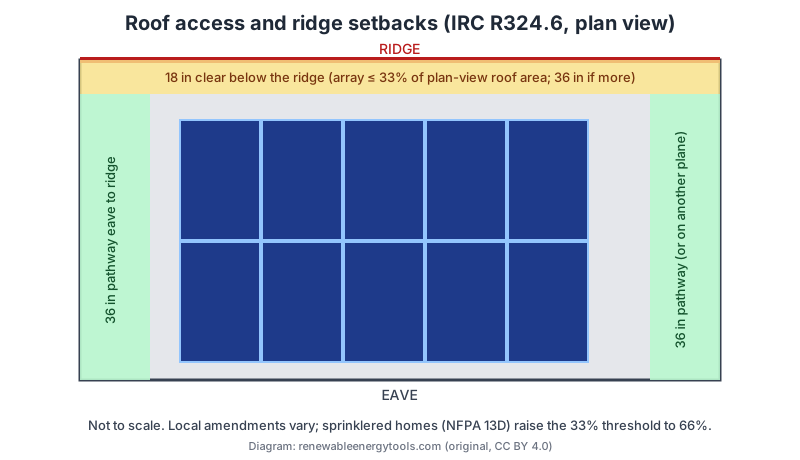
Diagram: renewableenergytools.com, based on IRC R324.6. Not to scale.
These rules trace back to the CAL FIRE Office of the State Fire Marshal’s Solar Photovoltaic Installation Guideline of April 2008, written with fire officials, building officials and the solar industry. The 2012 International Fire Code (Section 605.11) carried three-foot pathway rules nationally, and later IRC editions placed the residential version in R324.6.
The practical effect is lost roof area. On a small or heavily cut-up roof, pathways and setbacks can remove several module positions. That is why installers sometimes propose ground mounts, higher-wattage modules, or a sprinkler credit where a sprinkler system already exists. Our off-grid solar calculator can help check whether a smaller array still covers your daily load.
Other fire-code points inspectors check
- Emergency escape openings. Panels may not sit directly below bedroom egress windows, and a clear pathway to them is often required.
- Hips and valleys. Many editions require clearance along hips and valleys on at least one side.
- Labels. A rapid shutdown placard at the service equipment shows firefighters where to switch the array off.
What is solar rapid shutdown (NEC 690.12)?
Rapid shutdown is an NEC requirement that, when firefighters operate the initiator, conductors more than 1 foot outside the array drop to 30 volts or less within 30 seconds, and conductors inside the array boundary drop to 80 volts or less. It is why most new rooftop systems use microinverters or module-level power electronics.
The requirement first appeared in the 2014 NEC, which covered only conductors more than 10 feet from the array. The 2017 NEC defined the array boundary as 1 foot (305 mm) from the array in all directions and, from January 1, 2019, added the 80-volt limit inside it (IAEI Magazine; Mike Holt, 2020 NEC 690.12). An alternative path is a PV hazard control system listed to UL 3741.
| NEC edition | Controlled conductors | Limit | Time |
|---|---|---|---|
| 2014 | More than 10 ft from the array or 5 ft inside a building | 30 V, 240 VA | 10 s |
| 2017 and later | Outside the array boundary (1 ft) | 30 V | 30 s |
| 2017 (effective 2019) and later | Inside the array boundary | 80 V, or a listed PV hazard control system | 30 s |
Which edition applies depends on what your state has adopted, which can lag the newest NEC by one or two cycles.
What is the 120% rule for solar, and will my panel need an upgrade?
The 120% rule (NEC 705.12) lets solar backfeed a panel’s busbar up to 20% beyond its rating, provided the solar breaker sits at the opposite end from the main breaker: 125% of inverter output current + main breaker rating ≤ 120% of busbar rating. If your system breaks the rule, the options are a smaller system, a derated main breaker, a supply-side (line-side) connection, or a new panel.
Worked example: a 200 A panel
- Busbar rating 200 A, so 120% = 240 A.
- Main breaker 200 A. Room left for solar: 240 − 200 = 40 A of breaker.
- The breaker must be at least 125% of the inverter’s continuous output, so the maximum inverter output current is 40 ÷ 1.25 = 32 A.
- At 240 V, 32 A × 240 V = 7,680 W, so roughly 7.7 kW of AC inverter capacity.
| Busbar | Main breaker | Max solar breaker | Max inverter current | Approx. AC capacity at 240 V |
|---|---|---|---|---|
| 100 A | 100 A | 20 A | 16 A | 3.8 kW |
| 200 A | 200 A | 40 A | 32 A | 7.7 kW |
| 200 A | 175 A (derated) | 65 A | 52 A | 12.5 kW |
| 225 A | 200 A | 70 A | 56 A | 13.4 kW |
Calculated from the NEC 705.12 busbar rule as summarised by Solar Builder. The derated row assumes your load calculation allows the smaller main. Breakers come in standard sizes, so real limits can be slightly lower.
To convert between amps and kilowatts yourself, use the amps to kW converter.
How much does a solar permit cost?
Residential solar permit fees are set locally and are typically a few hundred dollars; California caps them at $450 for systems up to 15 kW plus $15 per extra kW (AB 1414, 2017). The bigger cost is time and labor, which installers pass on in their price. Permitting is one of the soft costs in our solar panel cost breakdown.
Berkeley Lab researchers quantified that hidden cost. Burkhardt et al. (2015) found that permitting alone accounted for about $0.18 per watt between the least and most favourable jurisdictions, and that when other local regulatory procedures were included the gap widened to $0.64 to $0.93 per watt, at least $2,500 on a typical 5 kW system.
Other costs that can appear in the permit stage:
- Structural engineer’s letter, when the AHJ requires a stamped analysis.
- Main panel upgrade when the 120% rule fails, commonly the largest surprise.
- Utility interconnection fee, set in each state’s interconnection rules; small residential systems are often free or low cost.
- Re-inspection fees after a failed inspection.
To compare those costs with the savings, run your bills through the electricity cost calculator.
How long does solar permitting and interconnection take?
With instant permitting, NREL measured a median of 33 days from permit submission to passed final inspection for SolarAPP+ projects in 2023, versus 47.5 days for traditionally permitted projects, about 31% faster (NREL). Utility PTO is then a separate wait.
NREL also estimated that SolarAPP+ saved about 15,400 hours of permitting staff time in 2023. The longest delays usually come from three places: a backlog at the plan review desk, correction cycles for incomplete documents, and the utility’s interconnection queue, especially where a feeder already hosts a lot of solar.
What is SolarAPP+?
SolarAPP+ (Solar Automated Permit Processing Plus) is a free, web-based tool from the National Renewable Energy Laboratory that checks a standard residential solar or solar-plus-battery design against code and issues a permit instantly. The city still inspects the finished work. California’s SB 379 (2022) requires most cities and counties to offer automated, real-time residential solar permitting, with deadlines in 2023 or 2024 depending on population; very small cities and counties are exempt.
What happens at a solar inspection?
The inspector compares the finished system with the approved plans and checks the attachments, wiring, grounding, labels, disconnects and rapid shutdown. If anything differs, you get a correction notice and a re-inspection.
Common reasons systems fail inspection:
- Missing or wrong NEC labels and placards.
- Equipment swapped from the approved spec sheet without a plan revision.
- Conduit or modules blocking a fire pathway or ridge setback.
- Loose or missing grounding and bonding connections.
- A backfed breaker that breaks the 120% rule or sits in the wrong busbar position.
- Roof penetrations not flashed and sealed as shown on the plans.
Some AHJs require the installer to be on site and to provide a ladder and roof access. A few allow photo or video inspections for simple residential systems.
What is a solar interconnection agreement and permission to operate?
An interconnection agreement is the contract between you and your utility that sets the technical and billing terms for connecting your system to the grid; permission to operate is the utility’s final written approval to switch it on. Net metering terms are usually part of, or attached to, this agreement.
The rules come from your state utility commission. Most states give small inverter-based systems certified to UL 1741 and the IEEE 1547 standard a simplified review; the standard’s 2018 revision added grid-support functions such as voltage and frequency ride-through. Expect to provide the system size, inverter model, SLD and, at the end, the passed inspection. The utility may replace your meter with a bidirectional net meter before granting PTO.
Off-grid systems with no grid connection skip this step entirely; see our off-grid solar system guide for how those are designed.
Can I install solar panels myself?
Often yes: many jurisdictions issue owner-builder permits to homeowners, but a DIY system must pass the same plan review and inspections, and the utility must still approve the interconnection. Some utilities, lenders and incentive programs only accept systems installed by licensed contractors.
If you go DIY, buy equipment only after the permit drawings are approved, use listed components that match the spec sheets you submitted, and plan for a licensed electrician to make the final connection at the main panel if your AHJ requires it. Read how solar panels work to understand string voltage and current before designing one, and check the solar energy pros and cons to set realistic expectations.
History of solar permitting and interconnection rules
Rules for home solar grew in three waves: a federal right for small generators to sell power in the late 1970s, technical interconnection standards in the 2000s, and fire-safety and fast-permitting rules after rooftop solar became common.
| Year | Milestone | Source |
|---|---|---|
| 1978 | PURPA requires utilities to buy power from qualifying small generators | FERC |
| 2003 | IEEE 1547 published, the first US standard for interconnecting distributed resources | Wikipedia |
| 2008 | CAL FIRE-OSFM Solar Photovoltaic Installation Guideline sets roof access pathways (April) | Placer County copy |
| 2012 | International Fire Code Section 605.11 adds three-foot PV roof pathways | IFC 2012 |
| 2013 | Berkeley Lab links city permitting processes to installed prices in California | Dong & Wiser |
| 2014 | NEC 690.12 rapid shutdown first required | IAEI |
| 2017 | NEC defines the 1-foot array boundary; 80 V inside limit from 2019 | IAEI |
| 2017 | California AB 1414 caps residential solar permit fees at $450 (≤15 kW) | California Legislature |
| 2018 | IEEE 1547-2018 adds smart-inverter grid support | Wikipedia |
| 2022 | California SB 379 mandates automated residential solar permitting | California Assembly |
| 2023 | SolarAPP+ median 33 days to passed inspection vs 47.5 days traditional | NREL |
Scientific references
- Burkhardt, J., Wiser, R., Darghouth, N., Dong, C. G., & Huneycutt, J. (2015). “Exploring the impact of permitting and local regulatory processes on residential solar prices in the United States.” Energy Policy, 78, 102–112. doi:10.1016/j.enpol.2014.12.020
- Dong, C., & Wiser, R. (2013). “The impact of city-level permitting processes on residential photovoltaic installation prices and development times: An empirical analysis of solar systems in California cities.” Energy Policy, 63, 531–542. doi:10.1016/j.enpol.2013.08.054
- NFPA 70, National Electrical Code, Articles 690 and 705 (2017, 2020 and 2023 editions). National Fire Protection Association.
- International Code Council, International Residential Code, Section R324 Solar Energy Systems (2021 edition).
- IEEE 1547-2018, Standard for Interconnection and Interoperability of Distributed Energy Resources with Associated Electric Power Systems Interfaces.
Bottom line
A solar panel installation permit is rarely optional. Plan for two approvals, the local permit and the utility’s PTO, and design the roof layout around the fire rules from the start: 36-inch pathways from eave to ridge and an 18-inch ridge setback while the array stays at or under 33% of the plan-view roof (36 inches above that). Check the main panel against the 120% rule before you sign, because a panel upgrade is a common surprise cost. Where your city uses instant permitting such as SolarAPP+, the median job reached a passed inspection in about a month in 2023. Size your system first with the solar panel calculator, then let the permit set confirm what fits on your roof.
FAQ
Frequently asked questions
Do I need a permit to install solar panels?
In almost all US cities and counties, yes. A grid-tied rooftop system normally needs an electrical permit and often a building or structural permit, and the utility must approve the interconnection before you switch it on. A few jurisdictions exempt very small or off-grid systems, so check with your local building department, which code officials call the authority having jurisdiction (AHJ).
What is the 33% rule in solar panels?
It is a fire-code roof-coverage threshold in the International Residential Code (R324.6.2). If the solar array covers 33% or less of the roof's plan-view area, panels must stay at least 18 inches from each side of a horizontal ridge. Above 33%, the setback grows to 36 inches. In homes with an NFPA 13D sprinkler system the threshold rises to 66%.
How long does it take to get a solar permit?
It ranges from same day to several weeks. Jurisdictions using NREL's SolarAPP+ issue code-compliant residential permits instantly, and NREL found the median time from submission to passed final inspection was 33 days with SolarAPP+ in 2023, against 47.5 days for traditional review. Utility interconnection approval and PTO can add days to weeks after that.
How much does a solar permit cost?
Fees are set locally, typically a few hundred dollars for a home system. California caps residential solar permit fees by law at $450 for systems of 15 kW or less, plus $15 for each kW above that (AB 1414, 2017). Your installer usually pulls the permit and includes the fee in the quote, along with any engineering stamps the building department asks for.
Can I install my own solar panels?
Many jurisdictions allow homeowners to pull an owner-builder permit and install their own system, but the work must pass the same plan review and inspections, and the utility still has to approve the interconnection. Some utilities and incentive programs require a licensed contractor. Check with your building department and utility before buying equipment.
What license is needed to install solar panels?
It depends on the state. Electrical work on a solar system is usually done by, or under, a licensed electrician or electrical contractor. Some states have a dedicated solar license, such as California's C-46 Solar Contractor classification. NABCEP certification is a voluntary industry credential, not a government license.
What is permission to operate (PTO) for solar?
PTO is the utility's written approval to turn on a grid-connected system. It comes after the local final inspection passes and the utility has reviewed the interconnection application, sometimes swapped or reprogrammed the meter and signed the net metering agreement. Running a grid-tied system before PTO can breach the interconnection agreement.
What is the 120% rule for solar?
It is an NEC 705.12 limit on how much solar you can backfeed into a main panel. When the solar breaker sits at the opposite end of the busbar from the main breaker, 125% of the inverter's output current plus the main breaker rating must not exceed 120% of the busbar rating. A 200 A panel with a 200 A main allows a 40 A solar breaker.
13 Sources
- ICC, 2021 International Residential Code, Section R324 Solar Energy Systems
- Larimer County, Solar array roof layout, residential (reproduces IRC R324.6, 2022)
- NREL, Safe and fast permitting using SolarAPP+ continued to grow throughout 2023 (2024)
- DOE, Walk Me Through It: A Step-by-Step Guide for Consumers Going Solar
- IAEI Magazine, NEC rapid shutdown requirements and UL 3741
- Mike Holt, 2020 NEC 690.12 Rapid Shutdown (PDF)
- Solar Builder, NEC 2020 705.11 load and supply side connections
- California Legislature, AB 1414 (2017) solar permit fees
- California Assembly, SB 379 (Wiener, 2022) analysis: automated residential solar permitting
- Placer County, CAL FIRE-OSFM Solar Photovoltaic Installation Guideline (April 2008)
- Berkeley Lab, Burkhardt et al. (2015), permitting and local regulatory processes and residential solar prices
- FERC, PURPA Qualifying Facilities
- Wikipedia, IEEE 1547
Published October 25, 2026 · updated October 25, 2026 by Izhar Ahmad Danish. Part of our renewable energy guide. Found an error? Tell us.