Quick answer
Tidal energy is electricity generated from the rise and fall of ocean tides, using barrages, lagoons or underwater turbines. Wave power captures energy from surface waves. Together, ocean energy totaled only about 494 MW worldwide at the end of 2024 (IRENA), almost all from two tidal barrages: La Rance in France and Sihwa in South Korea.
Key facts
- About 494 MW of ocean energy was installed worldwide at the end of 2024 (IRENA); REN21 estimates about 513 MW.
- 254 MW: Sihwa Lake in South Korea, opened in 2011, is the largest tidal power station (PNNL Tethys).
- 240 MW: La Rance in France has generated tidal power since 1966 with 24 turbines (EDF).
- 50 GWh: MeyGen in Scotland became the first tidal stream array to pass 50 GWh of output, in 2023.
- 1.6 MW of ocean power capacity was added worldwide in 2024 (REN21).
On this page
- What is tidal energy?
- How does tidal energy work?
- What is wave power energy?
- What are the largest tidal power plants?
- How much ocean energy is there in the world?
- Why is tidal and wave energy so small?
- What are the advantages and disadvantages of tidal energy?
- Is there tidal or wave energy in the United States?
- Is ocean energy renewable?
- History of tidal and wave energy
- Scientific references
- Bottom line
- Frequently asked questions
The ocean holds enormous amounts of energy in its tides and waves, and engineers have been trying to tap it for more than half a century. France built the first large tidal power station in 1966, and it still runs. Yet tidal and wave power remain the smallest branch of renewable energy, with global capacity measured in hundreds of megawatts rather than gigawatts.
This guide explains how tidal energy and wave power work, the main technologies (barrages, tidal stream turbines, lagoons and wave energy converters), the projects that actually produce electricity, and why ocean energy has stayed small.
What is tidal energy?
Tidal energy is renewable energy captured from the rise and fall of ocean tides and the currents they create. It is driven by the gravitational pull of the moon and sun combined with Earth’s rotation, which makes it one of the most predictable energy sources on Earth.
Tides rise and fall roughly twice a day on most coasts. The difference between high and low water is called the tidal range, and it varies enormously by location: some bays and estuaries have ranges of many meters, while much of the open coastline has small tides. Tidal energy projects only work at the handful of sites where either the range or the currents are large.
Tidal energy is sometimes called tidal hydropower because the most established technology, the tidal barrage, works much like a low-head hydroelectric dam. If you know how a river dam works (see hydroelectric power), you already understand most of a tidal barrage.
How does tidal energy work?
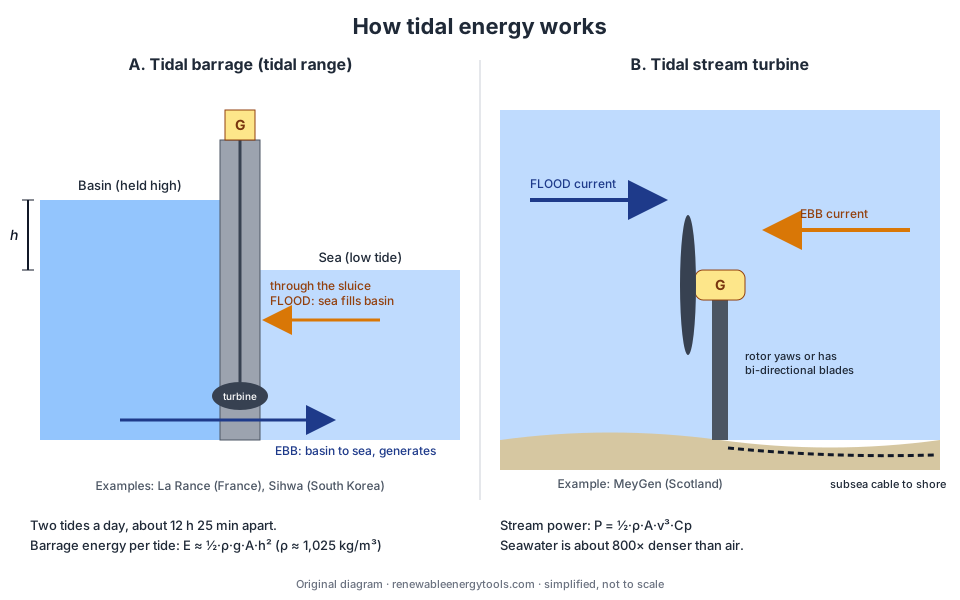
Tidal energy works by letting tidal water flow through turbines, either by holding it behind a barrier and releasing it (tidal range) or by placing turbines directly in fast-moving tidal currents (tidal stream). In both cases the turbine spins a generator that produces electricity.
Tidal barrages
A tidal barrage is a dam built across the mouth of a bay or estuary. Its operating cycle is:
- Flood tide: as the tide rises, sluice gates open and water fills the basin behind the barrage.
- High tide: the gates close, trapping water in the basin.
- Ebb tide: as the sea level outside falls, a height difference (head) builds up between the basin and the sea.
- Generation: the trapped water is released through turbines, generating electricity until the levels nearly equalize.
- Repeat: some plants also generate on the incoming tide, or pump water to boost the head.
Tidal lagoons
A tidal lagoon works on the same principle as a barrage, but instead of blocking an entire estuary, it encloses part of the coastline with a breakwater wall. This aims to reduce the impact on the estuary. No large tidal lagoon has been built yet. The best-known proposal, the 320 MW Swansea Bay Tidal Lagoon in Wales, was rejected by the UK government in June 2018 because it did not meet value-for-money requirements (Physics World).
Tidal stream turbines
Tidal stream turbines are underwater rotors placed in strong tidal currents, working much like wind turbines but in water. Because seawater is about 800 times denser than air, a slower current can deliver a lot of power to a smaller rotor. Turbines are mounted on the seabed or hang from floating platforms; Bahaj (2011) reviews the main tidal stream and wave designs. You can compare the physics with wind using our wind turbine calculator.
| Technology | How it works | Example | Status |
|---|---|---|---|
| Tidal barrage | Dam across an estuary; water released through turbines | La Rance (France), Sihwa (South Korea) | Commercial, mature but rare |
| Tidal lagoon | Breakwater encloses a section of coast | Swansea Bay (UK) proposal | None built at scale |
| Tidal stream | Underwater turbines in fast currents | MeyGen (Scotland) | Pre-commercial arrays |
| Wave energy converter | Devices capture motion of surface waves | Mutriku (Spain) | Demonstration and early commercial |
What is wave power energy?
Wave power is energy captured from the up-and-down and back-and-forth motion of ocean surface waves. Waves are created by wind blowing over the sea, so wave energy is ultimately a form of solar energy, since the sun drives the winds.
Unlike tides, waves are not predictable years in advance, but they are steadier than wind over short periods and reach far more coastlines than strong tides. The main types of wave energy converter, as classified in the review by Falcão (2010), are:
- Oscillating water column (OWC): a partly submerged chamber open to the sea below. Waves push the water inside up and down, forcing air through a turbine at the top.
- Point absorber: a floating buoy that moves with the waves; the motion drives a generator or hydraulic system.
- Attenuator: a long, jointed floating structure lying parallel to the waves. Its segments flex as waves pass, and the motion at the joints generates power.
- Oscillating wave surge converter: a hinged flap on the seabed near shore that swings back and forth with the waves.
- Overtopping device: waves spill into a raised reservoir, and the water drains back through low-head turbines.
The longest-running grid-connected wave plant is Mutriku in Spain’s Basque Country. Built into a harbor breakwater, it has 16 oscillating water column chambers with Wells turbines and a total capacity of 296 kW. It began operating in 2011, and passed 2 GWh of cumulative output in February 2020 (Offshore Energy). Since 2019 it has been part of the BiMEP marine energy test center.
Tidal vs wave in one sentence
Tidal energy comes from the moon and sun pulling the oceans; wave energy comes from wind blowing across them. Tides are predictable to the minute, while waves follow the weather.
What are the largest tidal power plants?
The largest tidal power plant in the world is the Sihwa Lake Tidal Power Station in South Korea, at 254 MW, followed by La Rance in France at 240 MW. These two tidal barrages account for most of the world’s ocean energy capacity.
| Project | Country | Type | Capacity | Opened | Annual output |
|---|---|---|---|---|---|
| Sihwa Lake | South Korea | Tidal barrage (on an existing seawall) | 254 MW (10 x 25.4 MW) | 2011 | Over 550 GWh (PNNL Tethys) |
| La Rance | France | Tidal barrage | 240 MW (24 turbines) | 1966 | Roughly 500 GWh a year |
| MeyGen Phase 1A | UK (Scotland) | Tidal stream array | 6 MW (4 x 1.5 MW) | 2016 onward | First tidal stream array past 50 GWh cumulative (2023) |
| Mutriku | Spain | Wave (oscillating water column) | 296 kW | 2011 | 2 GWh cumulative by 2020 |
Sources: PNNL Tethys, CNBC, Offshore Energy. La Rance’s yearly output varies by source and year, roughly 490 to 520 GWh in reported years.
La Rance, France
La Rance, on the Rance estuary in Brittany, opened on November 26, 1966, and is operated by EDF (PNNL Tethys). Its 24 turbines give a peak output of 240 MW. For 45 years it was the largest tidal power station in the world, and it remains the clearest proof that a tidal barrage can run reliably for decades.
Sihwa Lake, South Korea
Sihwa Lake, operated by the Korea Water Resources Corporation (K-water), opened in 2011. It was built into an existing seawall that had been constructed for land reclamation; opening the wall to tidal flow also improved water quality in the polluted lake behind it. Its ten 25.4 MW turbines generate on the incoming tide.
MeyGen, Scotland
MeyGen, in the Pentland Firth between mainland Scotland and Orkney, is the world’s leading tidal stream array. Its first phase has four 1.5 MW turbines (6 MW in total). In February 2023 it became the first tidal stream array to generate 50 GWh (CNBC), and the operator reported its longest-running turbine had averaged 95% availability since December 2018. The site is now run by Ampeak Energy, formerly SAE Renewables.
How much ocean energy is there in the world?
Very little is installed. IRENA reports about 494 MW of ocean energy capacity worldwide at the end of 2024; REN21 estimates about 513 MW. Either way, two tidal barrages make up most of it.
Growth is slow. REN21 counted just 1.6 MW of new ocean power capacity added worldwide in 2024. Ocean Energy Europe reported about 1.4 MW of new tidal stream capacity and 130 kW of wave devices deployed in Europe that year, and cumulative ocean energy electricity production in Europe of 106 GWh by 2024. It also tracked a pipeline of about 165 MW of publicly funded European projects planned over five years, mostly tidal stream.
| Metric | Value | Source |
|---|---|---|
| Global ocean energy capacity, end of 2024 | About 494 MW | IRENA |
| Global ocean energy capacity, end of 2024 (alternative estimate) | About 513 MW | REN21 GSR 2025 |
| New ocean capacity added worldwide in 2024 | 1.6 MW | REN21 |
| Cumulative ocean energy electricity in Europe | 106 GWh (to 2024) | Ocean Energy Europe |
| Global offshore wind capacity, for comparison | About 83 GW | GWEC, 2024 |
To put that in context, global offshore wind capacity at the end of 2024 (GWEC) was roughly 170 times larger than all ocean energy combined. Our offshore wind guide covers that industry.
Why is tidal and wave energy so small?
Tidal and wave energy remain small because suitable sites are rare, building and maintaining machines in seawater is expensive, barrages have heavy environmental impacts, and the industry has not reached the scale that drove down the cost of wind and solar.
- Few good sites. Tidal barrages need a large tidal range in a suitable estuary (Neill et al., 2018); tidal stream needs very fast currents. Only a limited number of locations qualify.
- Harsh environment. Saltwater corrosion, storms, biofouling and huge forces on structures make equipment costly to build and difficult to repair.
- High costs. Swansea Bay’s estimated £1.3 billion price tag was judged too high relative to alternatives such as offshore wind and nuclear power. For the UK’s sixth renewables auction, the government raised the ceiling price for tidal stream to £261/MWh (2012 prices), up 29% from £202/MWh (DESNZ methodology; Offshore Energy), compared with a global average of $0.034/kWh for new onshore wind in 2024 (IRENA).
- Environmental impacts. Barrages change sediment movement, water quality and tidal flats that birds and fish depend on.
- No cost-learning curve yet. With only a few megawatts added a year, manufacturers cannot mass-produce devices, so costs stay high.
- Many wave designs, no winner. Wind converged on the three-blade turbine decades ago. Wave energy still has many competing concepts.
- Grid connections. The best sites are often remote, far from demand and transmission lines.
Predictable is not the same as constant
Tides are predictable, but they are not constant. Output peaks and falls about four times a day as the tide turns, and varies with the monthly spring-neap cycle. Tidal power still needs storage or other generation to fill the gaps.
What are the advantages and disadvantages of tidal energy?
Tidal energy’s main advantage is predictability, along with long-lived infrastructure and no emissions during operation. Its main disadvantages are high costs, limited sites and local ecological impacts.
| Advantages | Disadvantages |
|---|---|
| Tides can be forecast years in advance | Very few suitable sites worldwide |
| No fuel and no emissions during operation | High capital and maintenance costs in seawater |
| Long-lived structures: La Rance has run since 1966 | Barrages alter estuaries, sediment and habitats |
| Water’s density means compact turbines for the power | Output varies through each tidal cycle |
| Tidal stream turbines are mostly out of sight | Still pre-commercial except for a few barrages |
Wave power shares many of the same pros and cons, with a larger potential resource but less predictable output and less mature technology.
Is there tidal or wave energy in the United States?
The US has no commercial-scale tidal or wave power plant operating. Activity is limited to research, test sites and demonstration projects supported by the Department of Energy’s Water Power Technologies Office and national laboratories.
Promising US resources include strong tidal currents in Alaska’s Cook Inlet, Puget Sound in Washington and the East River in New York, and wave energy along the Pacific coast of Oregon, Washington, California, Hawaii and Alaska. For now, these resources contribute essentially nothing to the US grid compared with wind, solar and hydroelectric power.
Is ocean energy renewable?
Yes, ocean energy is renewable. Tides are driven by the moon and sun and will keep occurring; waves are driven by wind, which is driven by the sun. Using these flows does not deplete them. Our renewable resources guide explains what makes a resource renewable, and renewable energy sources compares ocean energy with the other options.
The term “ocean energy” also covers two technologies with even less deployment: ocean thermal energy conversion (OTEC), which uses the temperature difference between warm surface water and cold deep water, and salinity gradient power, which uses the difference between fresh and salt water. Both remain at the research and pilot stage.
To estimate what a given amount of capacity would produce over a year, multiply power by hours, as shown in our kWh calculator.
History of tidal and wave energy
Tidal power is far older than electricity. Tide mills trapped water in a pond at high tide and released it through a waterwheel as the tide fell, exactly the principle of a modern barrage. Excavations at Nendrum Monastery in Strangford Lough, Northern Ireland, uncovered the world’s oldest known excavated tide mill, dated by tree rings to AD 619–621 (Current Archaeology). Hundreds of tide mills later operated along European and North American coasts.
Electricity from the tides arrived with La Rance in Brittany, opened on November 26, 1966, and still the world’s longest-running tidal power station (PNNL Tethys). Wave energy’s modern era began with the 1973 oil crisis. In 1974 Stephen Salter of the University of Edinburgh published “Wave power” in Nature, describing the nodding “Salter’s Duck,” which in tank tests captured a very high fraction of incoming wave energy (Salter, 1974).
The 2000s brought the first sea trials at scale. In 2004 the Pelamis P1, a 750 kW snake-like attenuator, became the first offshore wave machine to export electricity to a national grid, at the European Marine Energy Centre in Orkney (Pelamis). Three Pelamis machines formed the 2.25 MW Aguçadoura wave farm off Portugal in 2008, but it was taken ashore within months after technical and financial problems (Aguçadoura). The same year, the 1.2 MW SeaGen in Strangford Narrows became the first commercial-scale tidal stream generator (IMechE). South Korea’s 254 MW Sihwa Lake station overtook La Rance in 2011 (PNNL Tethys), and MeyGen’s four 1.5 MW turbines were installed in the Pentland Firth over the winter of 2016/17 (MeyGen).
| Year | Milestone | Source |
|---|---|---|
| AD 619–621 | Nendrum tide mill, Northern Ireland: oldest known excavated tide mill | Current Archaeology |
| 1966 | La Rance tidal barrage opens in France (240 MW) | PNNL Tethys |
| 1974 | Salter’s “Wave power” paper in Nature introduces the Salter Duck | Nature |
| 2004 | Pelamis P1 is the first offshore wave machine to feed a national grid (EMEC, Orkney) | Pelamis |
| 2008 | Aguçadoura, Portugal: first multi-machine wave farm (2.25 MW) | Aguçadoura |
| 2008 | SeaGen (1.2 MW): first commercial-scale tidal stream generator | IMechE |
| 2011 | Sihwa Lake (254 MW) becomes the largest tidal power station; Mutriku wave plant starts | PNNL Tethys, Offshore Energy |
| 2016/17 | MeyGen Phase 1A turbines installed in the Pentland Firth | MeyGen |
| 2018 | UK rejects the Swansea Bay tidal lagoon | Physics World |
| 2023 | MeyGen passes 50 GWh, a first for a tidal stream array | CNBC |
Scientific references
- Salter, S. H. (1974). “Wave power.” Nature, 249(5459), 720–724. doi:10.1038/249720a0
- Falcão, A. F. de O. (2010). “Wave energy utilization: A review of the technologies.” Renewable and Sustainable Energy Reviews, 14(3), 899–918. doi:10.1016/j.rser.2009.11.003
- Bahaj, A. S. (2011). “Generating electricity from the oceans.” Renewable and Sustainable Energy Reviews, 15(7), 3399–3416. doi:10.1016/j.rser.2011.04.032
- Neill, S. P., Angeloudis, A., Robins, P. E., et al. (2018). “Tidal range energy resource and optimization: Past perspectives and future challenges.” Renewable Energy, 127, 763–778. doi:10.1016/j.renene.2018.05.007
Bottom line
Tidal energy captures the rise and fall of the tides with barrages, lagoons and underwater turbines; wave power captures the motion of surface waves. Both are renewable and tides are uniquely predictable, but the whole world had only about 494 MW of ocean energy at the end of 2024 (IRENA), and almost all of it comes from two barrages: Sihwa (254 MW) and La Rance (240 MW).
Projects like MeyGen show tidal stream turbines can run reliably, yet high costs, few sites and environmental concerns keep ocean energy a niche. For how it compares with wind, solar, hydro, geothermal and biomass, explore our renewable energy homepage.
FAQ
Frequently asked questions
How does tidal energy work?
Tidal energy uses the movement of water caused by the gravitational pull of the moon and sun. A tidal barrage traps water behind a dam at high tide and releases it through turbines as the tide falls. Tidal stream turbines work like underwater wind turbines, spinning in fast tidal currents. Both drive generators to make electricity.
Is tidal energy renewable?
Yes. Tides are created by the gravitational pull of the moon and sun on the oceans combined with Earth's rotation, so they will keep occurring for as long as those bodies exist. Using tidal energy does not deplete the resource. That makes it one of the most predictable renewable sources, since tide times can be forecast years ahead.
What is the largest tidal power plant in the world?
The Sihwa Lake Tidal Power Station in South Korea is the largest, with 254 MW from ten 25.4 MW turbines. It opened in 2011 and generates over 550 GWh a year, according to PNNL's Tethys database. It overtook France's 240 MW La Rance station, which had held the title since 1966.
Which country is leading in tidal energy?
South Korea has the most installed tidal power, thanks to the 254 MW Sihwa Lake barrage opened in 2011, just ahead of France's 240 MW La Rance. For tidal stream turbines the UK leads: Scotland's MeyGen array became the first to pass 50 GWh of output, in 2023. Most other countries have only demonstration projects.
What is the difference between tidal and wave energy?
Tidal energy comes from the regular rise and fall of the tides and the currents they create, driven by the moon and sun. Wave energy comes from surface waves, which are created by wind blowing over the ocean. Tides are highly predictable; waves vary with weather, but they occur along many more coastlines.
Why don't we use tidal energy more?
Only a few coastlines have tides or currents strong enough, building in seawater is expensive and corrosive, barrages have large environmental impacts on estuaries, and the industry is still small, so costs have not fallen as they have for wind and solar. The UK rejected the 320 MW Swansea Bay tidal lagoon in 2018 on value-for-money grounds.
Is tidal energy expensive?
Yes, compared with wind and solar. In the UK's sixth Contracts for Difference auction, the government set the maximum price tidal stream projects could receive at £261 per MWh in 2012 prices, up 29% from £202. That is several times the cost of onshore wind, which averaged $0.034 per kWh worldwide in 2024 according to IRENA.
Does the US have tidal or wave power plants?
The US has no commercial-scale tidal or wave power plant in operation. Activity is limited to test sites and demonstration projects, such as wave and tidal test centers supported by the Department of Energy. Promising US resources include tidal currents in Alaska and Puget Sound and wave energy along the Pacific coast.
How much electricity does tidal energy produce?
Very little on a global scale. The two largest tidal barrages, Sihwa and La Rance, each produce roughly 500 GWh a year. The whole world had only about 494 MW of ocean energy capacity at the end of 2024, compared with roughly 83 GW of offshore wind, so ocean energy remains a niche technology.
21 Sources
- IRENA, Ocean energy (2024 data)
- REN21, Global Status Report 2025: Ocean power
- Ocean Energy Europe, Ocean Energy Stats and Trends 2024
- PNNL Tethys, La Rance tidal barrage
- PNNL Tethys, Sihwa tidal power plant
- CNBC, MeyGen passes 50 GWh milestone (February 2023)
- Offshore Energy, Mutriku wave plant hits 2 GWh mark (2020)
- Physics World, Tidal lagoon fallout (2018)
- GWEC, Global Offshore Wind Report 2025 (2024 data)
- Current Archaeology, Harnessing the tides: Nendrum tide mill (AD 619-621)
- Wikipedia, Pelamis wave energy converter (EMEC grid connection, 2004)
- Wikipedia, Aguçadoura Wave Farm (2008)
- IMechE, Case study: SeaGen (2008)
- Wikipedia, MeyGen (turbines installed 2016/17)
- UK DESNZ, CfD Allocation Round 6 administrative strike price methodology (2023)
- Offshore Energy, UK raises tidal energy strike price for next renewables auction
- IRENA, Renewable Power Generation Costs in 2024
- Salter (1974), Wave power, Nature
- Falcão (2010), Renewable and Sustainable Energy Reviews
- Bahaj (2011), Renewable and Sustainable Energy Reviews
- Neill et al. (2018), Renewable Energy
Published October 25, 2026 · updated October 25, 2026 by Izhar Ahmad Danish. Part of our renewable energy guide. Found an error? Tell us.